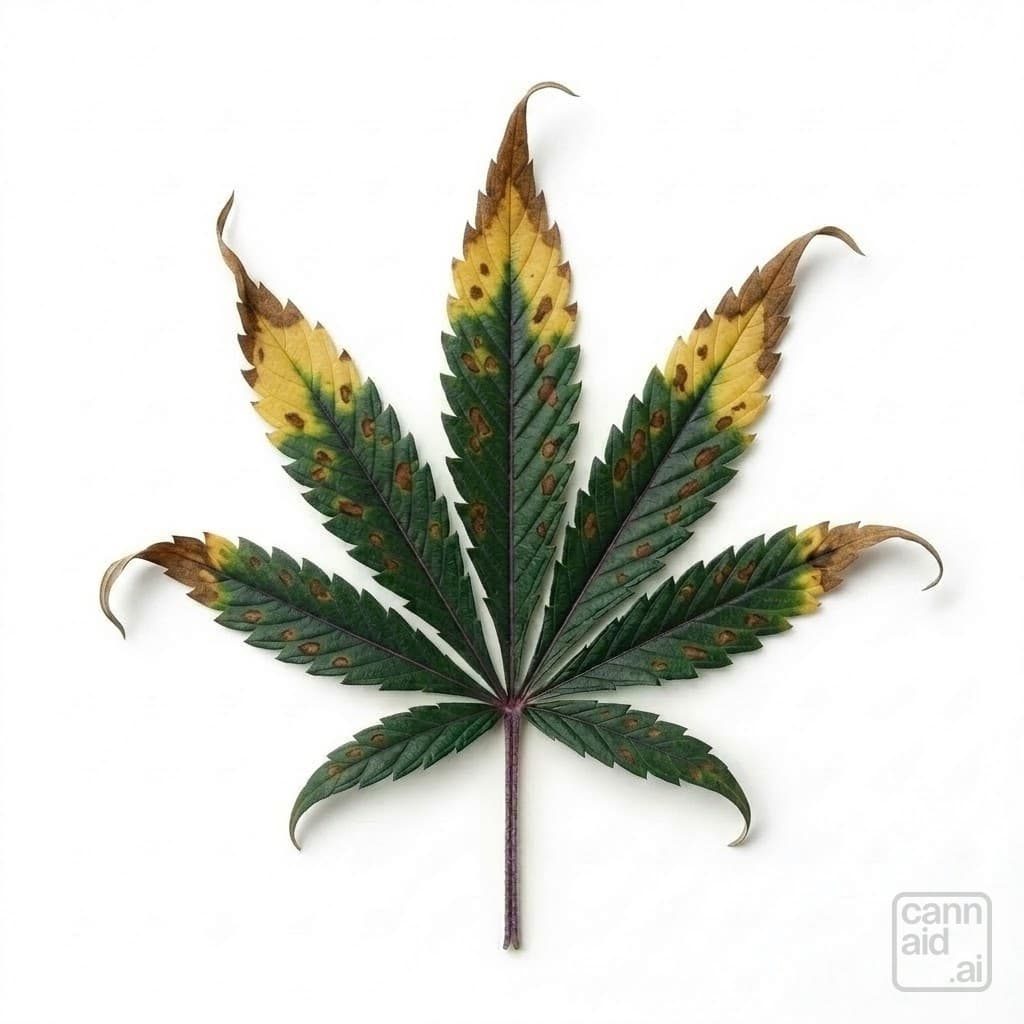
Dark leaves with blue/purple tint, leaves curl inward and downward
Copper is a micronutrient — your plant only needs tiny amounts of it, but those tiny amounts do real work. Cu powers electron transport in the cells, drives and respiration, and is required to build . It also runs lignin production — the structural compound that makes stems woody and rigid enough to hold up flowering colas as they pack on weight. Without enough copper, energy production sputters and the plant's structural frame goes flimsy.
Cu deficiency is rare in cannabis, but when it shows up the cause is almost always one of a small handful of things: above 7.5 in soil, 7.0 in coco or 6.6 in hydro (copper locks out at that level), excess zinc, iron, or phosphorus muscling it out at the root, or organic-heavy mixes like peat that bind copper tight and refuse to release it. Because copper is immobile, the deficiency hits new upper growth first — older leaves below stay normal. The diagnostic has two parts that show up together: the new leaves come in unnaturally dark — deep blue-green deepening toward ink-purple — with bright yellow or white tips that pop sharply against that dark body. Then as things progress, the leaf margins curl inward and downward. That downward curl is what separates Cu deficiency from , which pulls leaves upward into tacos. One important warning: the gap between copper deficiency and copper toxicity is narrow — go gentle with any supplementation.
Solutions
✓Apply copper sulfate or a copper-containing fungicide at low dose — only if deficiency is confirmed
✓Lower pH to 6.3–6.8 in soil, 5.8–6.0 in coco or 5.5–6.0 in hydro — copper locks out hard above 7.5 in soil, 7.0 in coco, 6.6 in hydro
✓This is a rare deficiency — verify before treating, because copper toxicity is easy to trigger and the margin is narrow
✓Reduce zinc, iron, or phosphorus if excessive — all three compete with copper for uptake
✓Avoid heavily amended organic soils or peat-heavy mixes that bind copper — add mineral amendments if needed
Plant Overview
How it moves through the plant
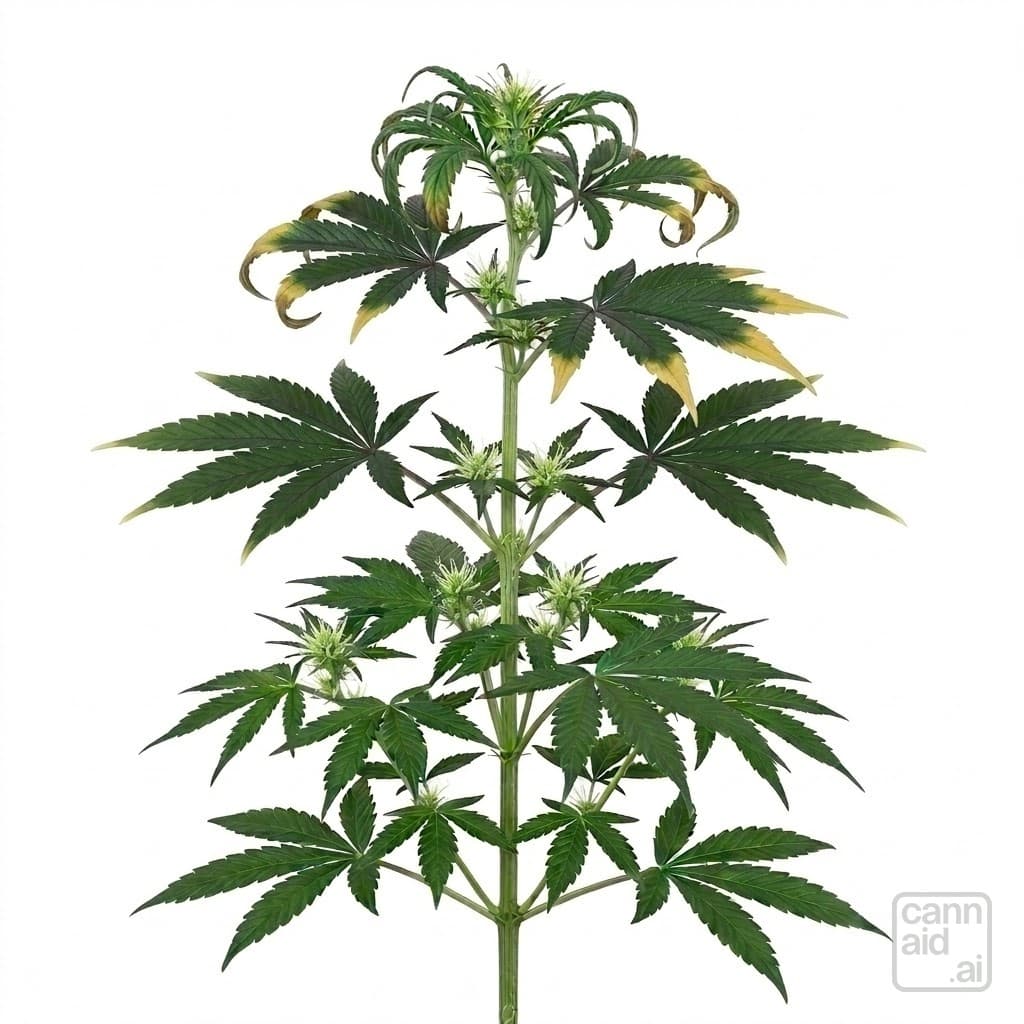
Copper is immobile, so the deficiency lives at the top of your plant. The lower leaves stay fine — all the action happens on the freshest growth. The signature is unmistakable once you know what you're looking for: the new leaves come in dark blue-green to ink-purple with bright yellow or white tips, and the leaf margins curl inward and downward. Lignin production drops in parallel with all this, so the stems go thin and weak — by the late stage they may struggle to hold up the weight of the buds they're trying to make.
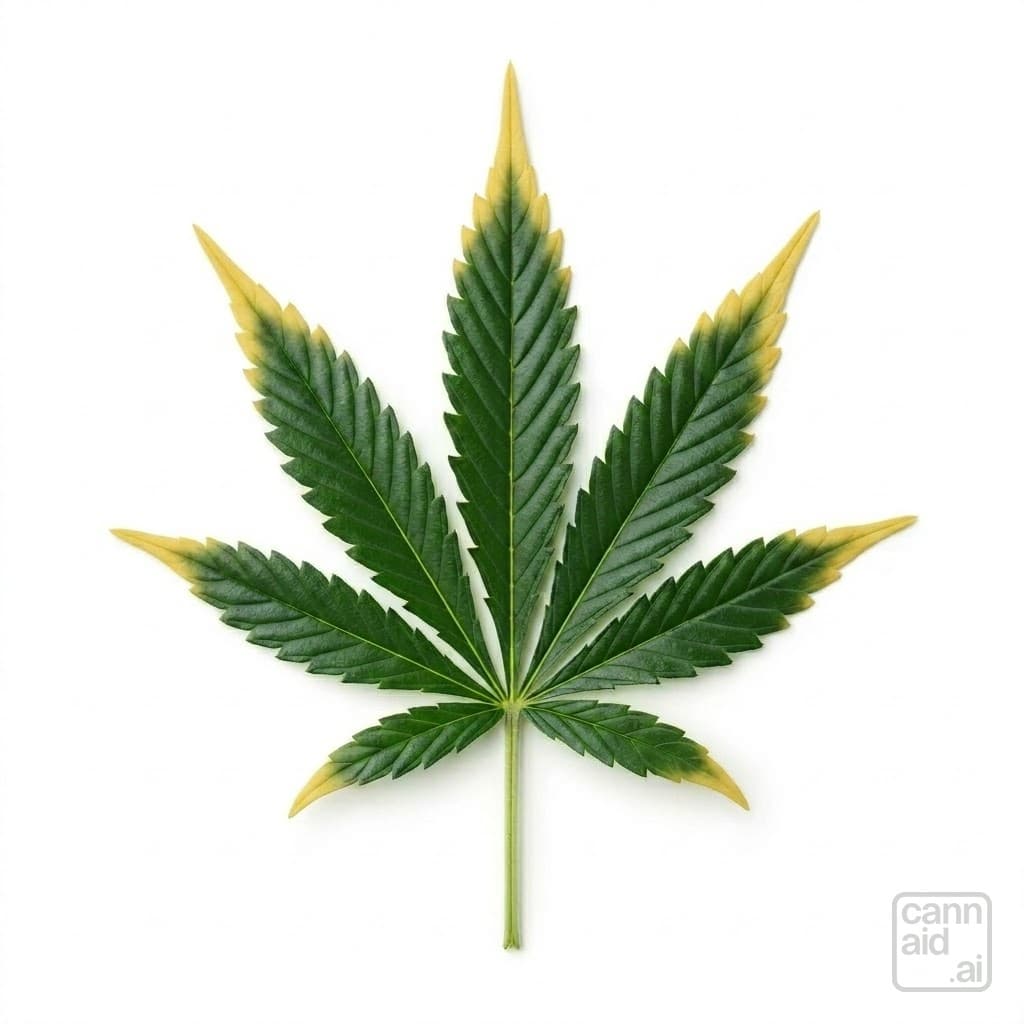
Early. Just the top one or two new leaves are off. They've come in noticeably darker than the rest of the plant, with bright yellow or white tips that pop sharply against the dark blue-green leaf body. Look down at the apex from above and the affected leaves stand out immediately. The growing tip may wilt slightly during the hottest hours of the day and bounce back overnight. Everything below looks fine. Growth at the apex has visibly slowed.
Mid. The dark blue-green has deepened toward ink-purple and now shows on multiple new leaves at the top, not just one or two. From a few feet away the upper reads as distinctly darker than the rest of the plant, with bright tips standing out against the dark leaf bodies in a striking contrast that catches your eye from across the tent. The leaf margins curl inward and downward, giving the upper leaves a cupped, distorted look. New growth has stalled noticeably; spacing at the apex tightens up.
Late. The top of the plant looks severely twisted and contorted — multiple leaves curled inward and downward into claw shapes, dark and warped. From across the room the upper canopy reads as visibly stuck while the rest of the plant has kept growing. Stems are thin and weak because lignin production has dropped, and they may struggle to support the weight of developing buds. If she's flowering, the buds fail to mature properly — small, less dense, with reduced development.
Early — how it first appears on a leaf
Pick up a new upper leaf in the early stage and the first thing you notice is the color: the body of the is unusually dark, a deep green with a slight blue or purple cast that doesn't match a normal healthy leaf. The tips are bright yellow or white, contrasting sharply against the dark body — that two-tone look is your diagnostic. The leaf surface has a faint metallic or waxy sheen. Touch the leaf and it feels stiff and rigid in your hand — not the soft wilt you'd expect from a stressed plant. and the leading into the leaf may show a hint of purple.
Mid — when the inward-downward curl appears
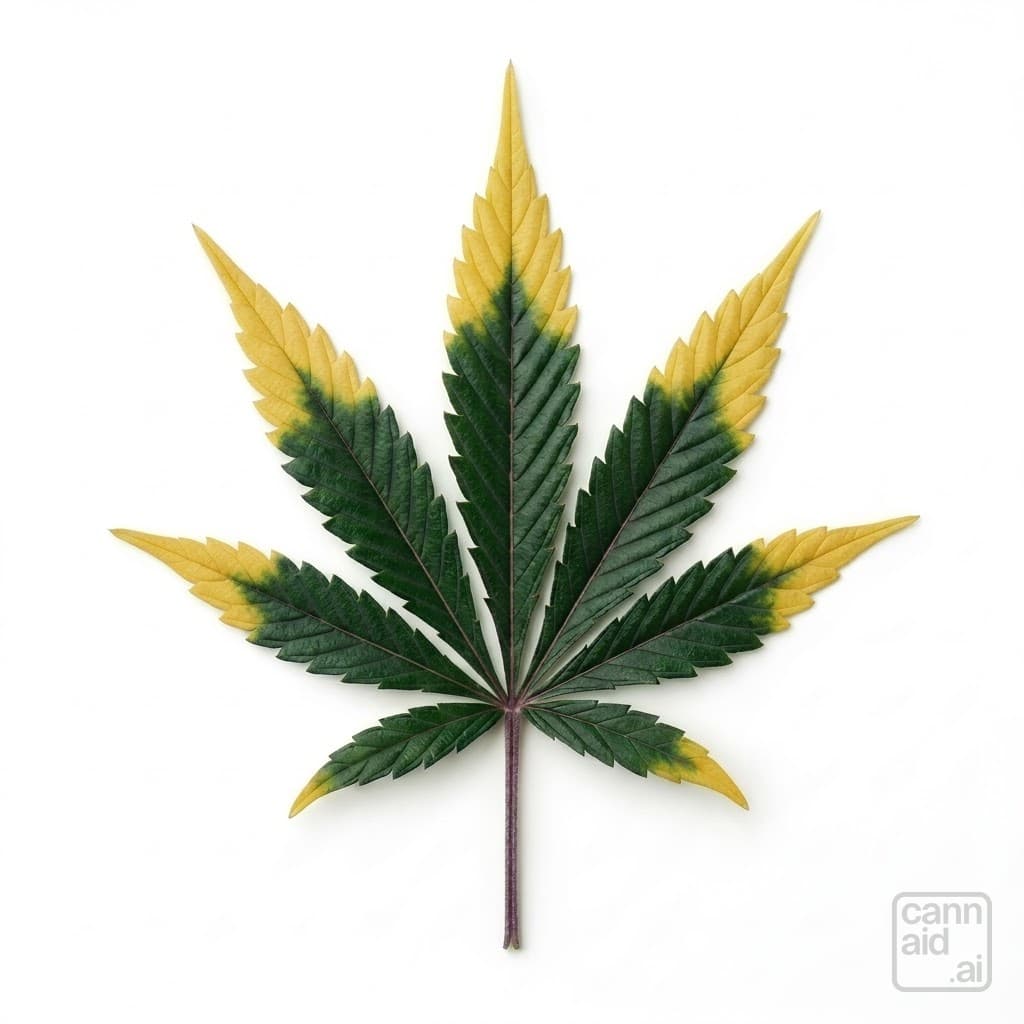
By the mid stage that same leaf's dark coloration has deepened toward an ink-like blue-purple across most of the blade. The yellow or white tips have grown more pronounced — bright streaks of color standing out against the dark leaf body. The margins distort and curl inward and downward, pulling the leaf into a cupped or claw-like shape. Even though the blade still feels stiff between your fingers, she's clearly stressed — slight wilting becomes visible. A fine (lighter tissue between veins, with the veins themselves staying darker) may start showing through too.
Late — past the point of recovery
By the late stage the leaf is severely twisted and contorted, margins pulled inward and downward into a pronounced claw. Yellow or white has spread from the tips well inward across the blade, and brown necrotic spots develop across the surface as cells die. The whole leaf looks crumpled. Tips and edges die back with the brown necrosis creeping inward. The petiole and the bit of stem leading into the leaf are noticeably weakened — lignin production has dropped, so the supporting structure is failing right along with the leaf itself.
Commonly Confused With
Nutrient Burn
Both affect leaf tips. Copper produces bright yellow or white tips on new growth with dark blue-green leaves. Nutrient burn produces brown crispy tips on leaves of any color throughout the plant.
Both cause yellowing. Copper affects new/upper leaves with dark blue-green coloring and inward-downward curling tips. Nitrogen affects old/lower leaves with overall pale green. Location separates them — top = copper, bottom = nitrogen.