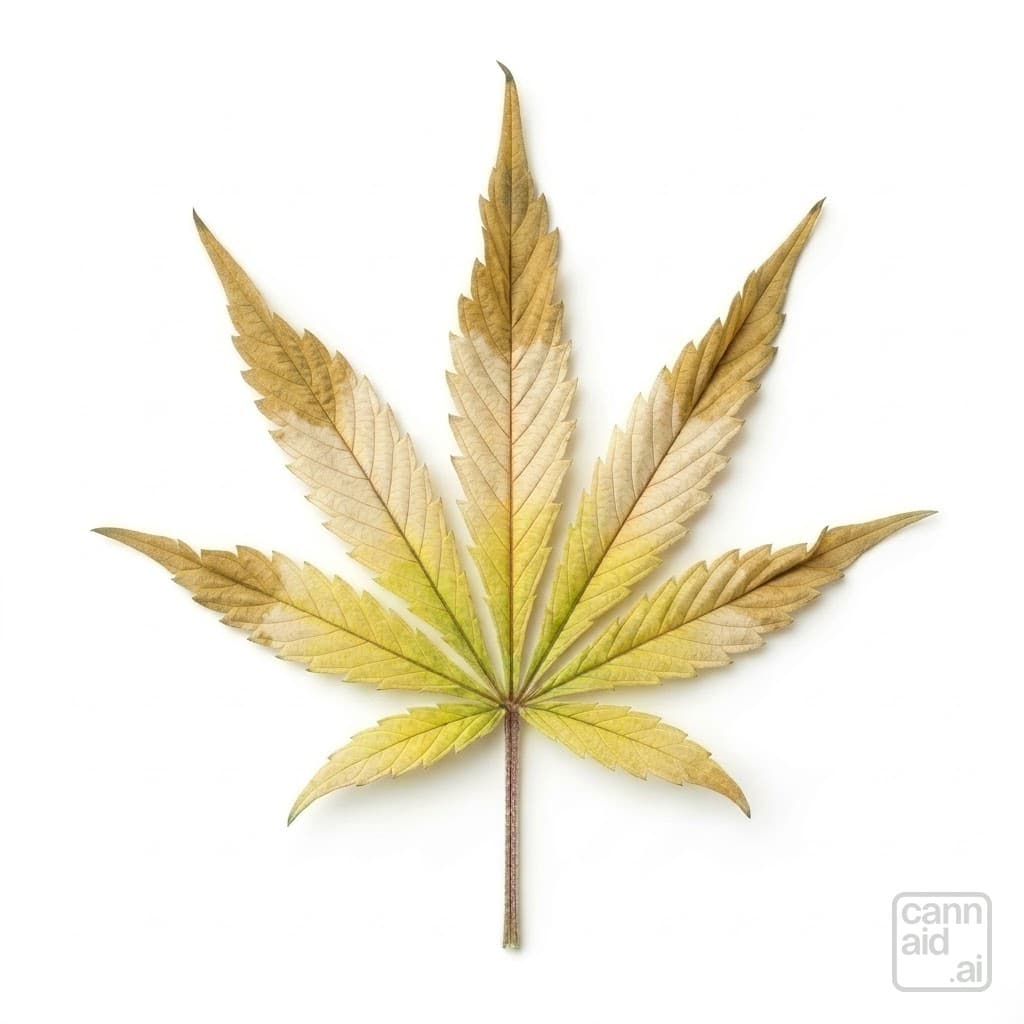
Nitrogen is the workhorse nutrient in cannabis — there's more of it in a healthy plant than any other element, and almost everything that makes a leaf green and a plant grow runs through it. It builds chlorophyll (the pigment that turns sunlight into food), it builds the proteins and amino acids that hold the plant together, and during the it's the single biggest driver of how fast your plant fills out and how big her leaves get. A well-fed plant in veg looks deep, vibrant green — that's nitrogen at work.
Deficiencies show up when the plant's appetite outruns what the roots can deliver. That happens during rapid vegetative growth, when a pot has become , or when has suffocated the roots so they can't drink properly. Cold root zones, low , and a salty all do the same thing — the nitrogen is there, the plant just can't get to it. One important caveat: a bit of yellowing on lower leaves during late flowering is completely normal. The plant is moving nitrogen out of the old and into the buds where it's actually needed. Don't try to fix that one — it's a feature, not a bug.
Solutions
✓Increase nitrogen in feeding schedule
✓Check pH — optimal 6.3–6.8 in soil, 5.8–6.0 in coco, 5.5–6.0 in hydro
✓Foliar feed with seaweed or fish-based products for quick uptake
✓Add blood meal or feather meal for soil grows
✓Ensure proper watering — overwatering limits N uptake
Plant Overview
How it moves through the plant
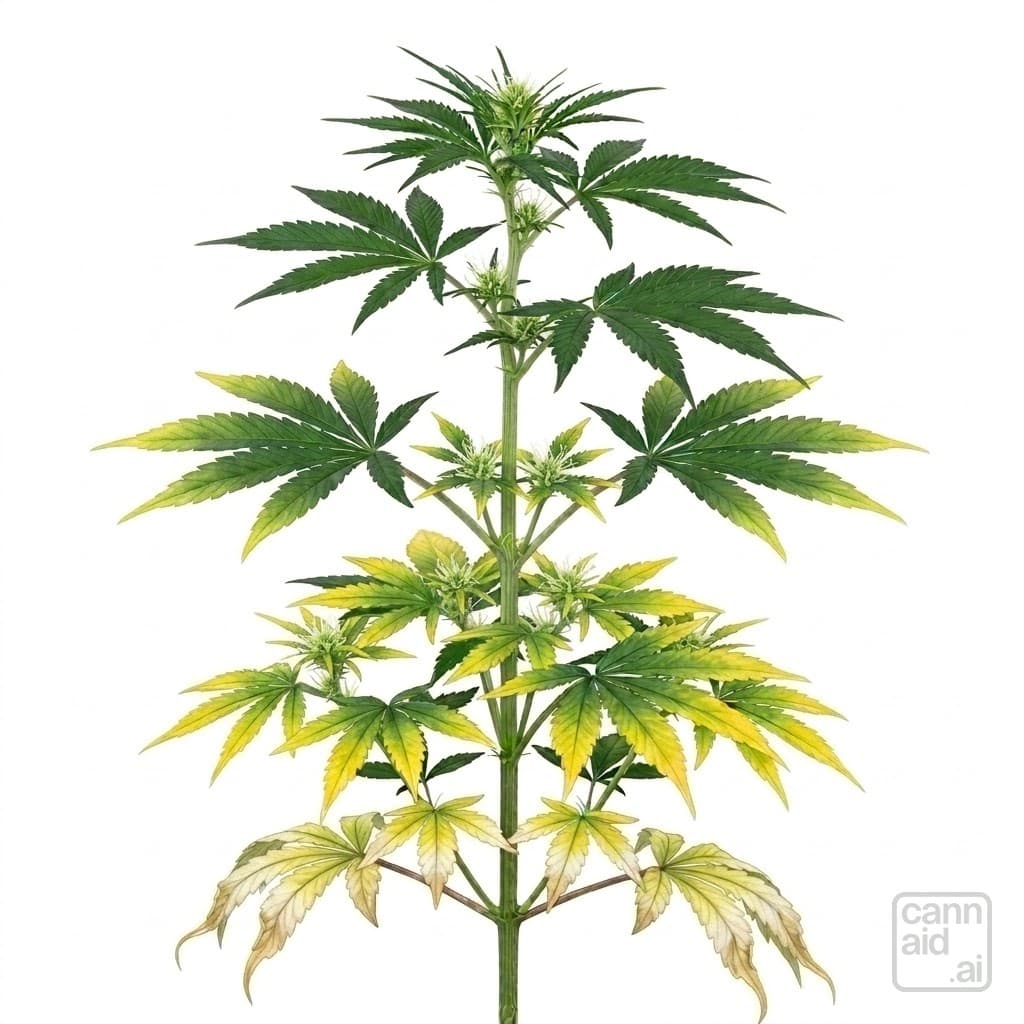
Nitrogen is a nutrient — which is a fancy way of saying the plant can move it around as needed. When she runs short, she does what any sensible organism would do: she robs from the old to feed the new. Nitrogen drains out of the lowest, oldest leaves and gets shipped up to the new growth at the top. That's why nitrogen deficiency always walks bottom-up — if you're seeing yellowing somewhere other than the bottom of the plant, it's not nitrogen.
Early. The lowest one or two go a soft, washed-out green — like the color got dialed down a notch. Everything above stays vibrant.
Mid. The wave climbs. The bottom leaves are now full-on yellow, the worst ones drop off when you brush past them, and from a few feet away the whole plant looks faintly tired — washed out next to a healthy reference.
Late. The bottom third is bald or crisping, the mid-canopy has gone bright yellow, growth has stalled, stems are getting thin and weak. If this hits in flower, the plant can rush to finish — small, airy, low-yield buds on the wrong schedule.
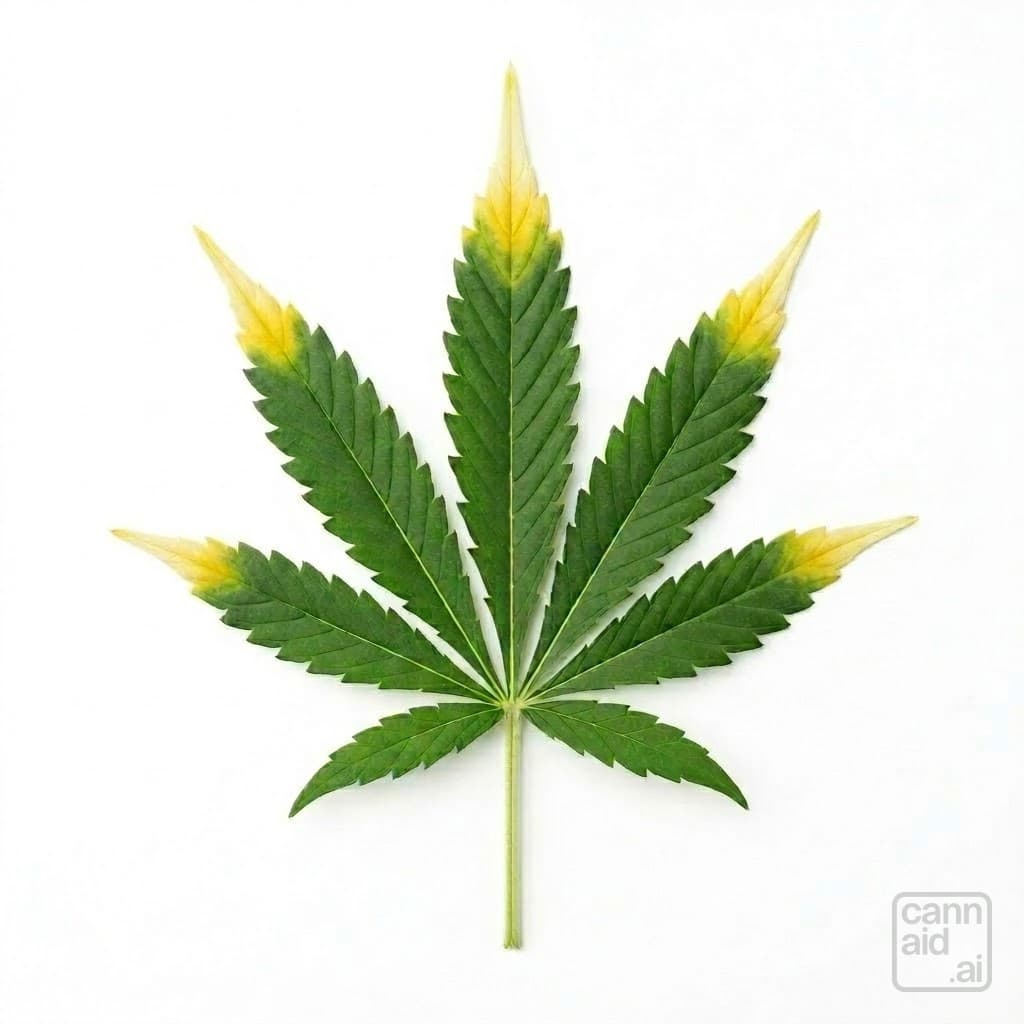
Early — how it first appears on a leaf
Pick up a single lower leaf in the early stage and you'll see a soft, even pale-green wash across the whole — like someone turned the saturation down a notch. There's nothing patchy or veiny about it. The fade together with the tissue, the edges fade together with the center, all at the same rate. That uniform fade is how you tell nitrogen apart from magnesium (where the veins stay sharply green) or potassium (where the edges scorch first). The fade usually starts at the tip and creeps inward. The leaf still feels soft and limp — not crispy yet — and may fold inward a little, like it's a bit deflated. New leaves coming in above may be slightly smaller than expected, since the plant is already rationing what nitrogen it has.
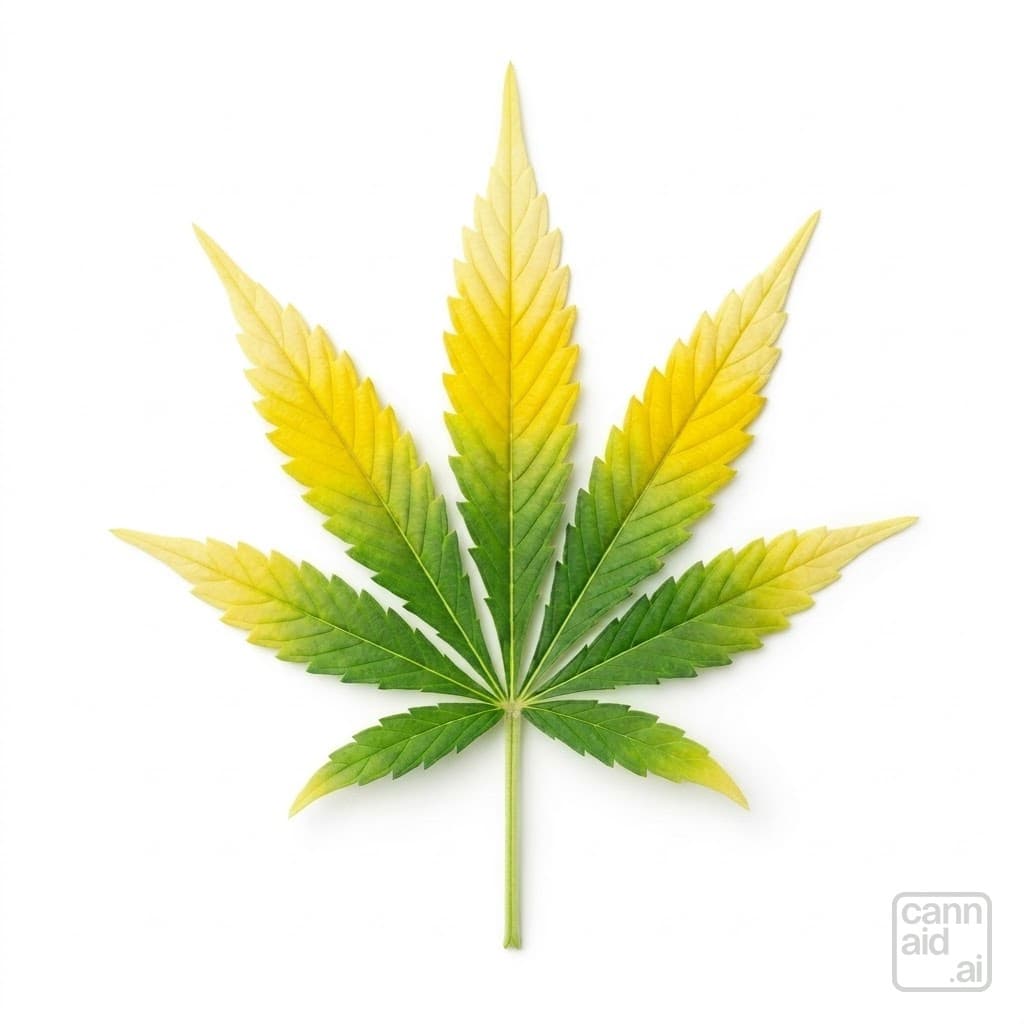
Mid — when chlorosis is unmistakable
By the mid stage, that same lower leaf is no longer "a bit pale" — it's fully yellow, veins and all. It still feels soft when you touch it, but the edges curl inward and the whole leaf hangs limp from the like it's running out of will. The worst ones drop off with the lightest brush of your hand. Look across the at this point and you'll see the same yellow wave on most of the leaves at the same height — not just one or two random ones. That uniformity is the giveaway that this is a real systemic issue and not, say, a leaf you accidentally scuffed against the tent wall.
Late — past the point of recovery
By the late stage the leaf is bright yellow throughout and starting to go crispy from the tip back. It folds and drops with essentially no resistance — touch it and you're holding it. and the bit of stem closest to the base may take on a dull reddish-brown tint, and entire lower branches may die back and shed. Here's the honest part: a leaf in this condition isn't coming back. The nitrogen has already been pulled out and reused weeks ago. Trying to "revive" the leaf is wasted effort — what you do now matters for everything above it. Severe and prolonged late-stage nitrogen starvation can cost you up to 72% of your final yield; the plant rushes to finish flowering with thin stems and airy, undersized buds.
Commonly Confused With
Potassium (K)
Both affect lower leaves. Nitrogen produces a soft, uniform yellow across the entire leaf including veins. Potassium yellows the margins first, then develops brown crispy edges within 3–5 days — a texture difference you can feel.
Both affect lower leaves. Nitrogen yellows the entire leaf uniformly — veins included. Magnesium keeps veins green while tissue between them yellows (interveinal chlorosis). If the veins are still green, it's magnesium.
Both can cause lower leaf yellowing and drooping. Overwatering produces firm, turgid leaves with wet soil that persists for days. Nitrogen deficiency causes progressive yellowing without whole-plant drooping, and the soil dries normally.