
Reveg: Her Second Youth
She keeps no calendar, only a clock. How a flowering plant walks back into veg, by accident or on purpose, and how to read the difference.
What you'll learn
- Why she reverts: she reads a clock, not a calendar. And why an autoflower never can.
- The month it takes: the stall, the single leaf, and the count back up to seven.
- True reveg against the three things mistaken for it: late pistils, foxtails, and regrowth after defoliation.
- The second harvest and the monster crop: what to cut, what to leave, and what to feed her.
A cannabis plant lives by the length of the night. Through the vegetative weeks the nights are short, and the plant builds. When the nights grow longer than half the day, she reads the season turning and begins to flower. Every stage after that runs one way: the stretch, the swelling, the ripening, on toward seed and the end of the year. Growers speak of the stages as a road with no way back. Only the ruderalis in an ignores the night. She flowers by age, and nothing you do with the lights can talk her out of it.
But the road is an illusion, and the clock is real. The plant keeps no calendar. She does not remember five weeks of flowering. She reads tonight's dark, and tomorrow's. If the nights turn short again, she believes the year has turned back, and she turns back with it. It is not graceful. She stalls for weeks. Then come leaves no seedling would be proud of, single-fingered, smooth and twisted, before her old shape returns. Growers call it , her second youth. It happens in two directions: the dark broke by accident, or you broke it on purpose.
By accident, it costs you a month and the shape of the harvest. The buds go leafy and stop fattening while the plant decides what she is. On purpose, it is a second harvest from a plant you already know. It keeps a phenotype without a mother, and it gives you a bush you never had to train. The reading is the same either way: the single leaf, the stalled bud, and the three things that look like reveg and are not. Learn it once. Then the difference between a ruined grow and a second one is a light-proof zip and a decision.
Her way back
Watch one thing to know where the plant stands: the number of fingers on the newest leaf. The last leaves she grew in flower had five or seven fingers, the fan leaf you know. After the lights go long again, the plant makes nothing at all for two or three weeks. No new leaf, no new hair: the plant seems asleep. Then the first new growth comes in as a single blade, rounded, smooth-edged and often twisted. The next leaf has three fingers. Then five. Seven fingers means veg again. The rest of this article starts from there.
How she counts her way back
Two directions
The same event, read from two sides. In one, the dark broke: a leak, a timer, a flip you reversed. The plant turned at the wrong time. In the other, you broke it yourself, after the cut or with a cutting. A plant that can walk back into youth can be asked to do it twice. The biology is identical. What differs is whether you were ready for the month it takes.
By accident — when the dark breaks
Everything she knows about the season, she learns in the dark. So everything that breaks the dark lies to her. A pin-sized gap in the tent wall. A timer running an hour late. A door opened at midnight for a quick look. An indicator glowing on a controller. In her first weeks of flower, any of them can read as the nights shortening again, and she believes what she reads. The is the only calendar a plant has. The earlier in flower, the easier she turns. A plant two weeks into bloom has barely committed, and lets go with almost no argument. Deep in flower she is more stubborn. The same leak makes the buds go leafy and throw fresh white hairs. It does not turn her all the way around. Either way, the buds stop fattening.
She tells you in order. First the hairs stop: the new white that appeared each day stop coming. Then the buds go leafy, small fan leaves pushing out of the crown of each cola where flower should be thickening. Then the leaf itself changes. It comes in smooth-edged, single-fingered, rounded and twisted, growing out of the top of the bud like something from another plant. That last sign is the one the diagnose survey reads too: single-pointed leaves on the upper growth of a flowering plant. Once you have seen it, it cannot be mistaken for anything else. A clone cut in flower shows the same signs, as in the photo below.
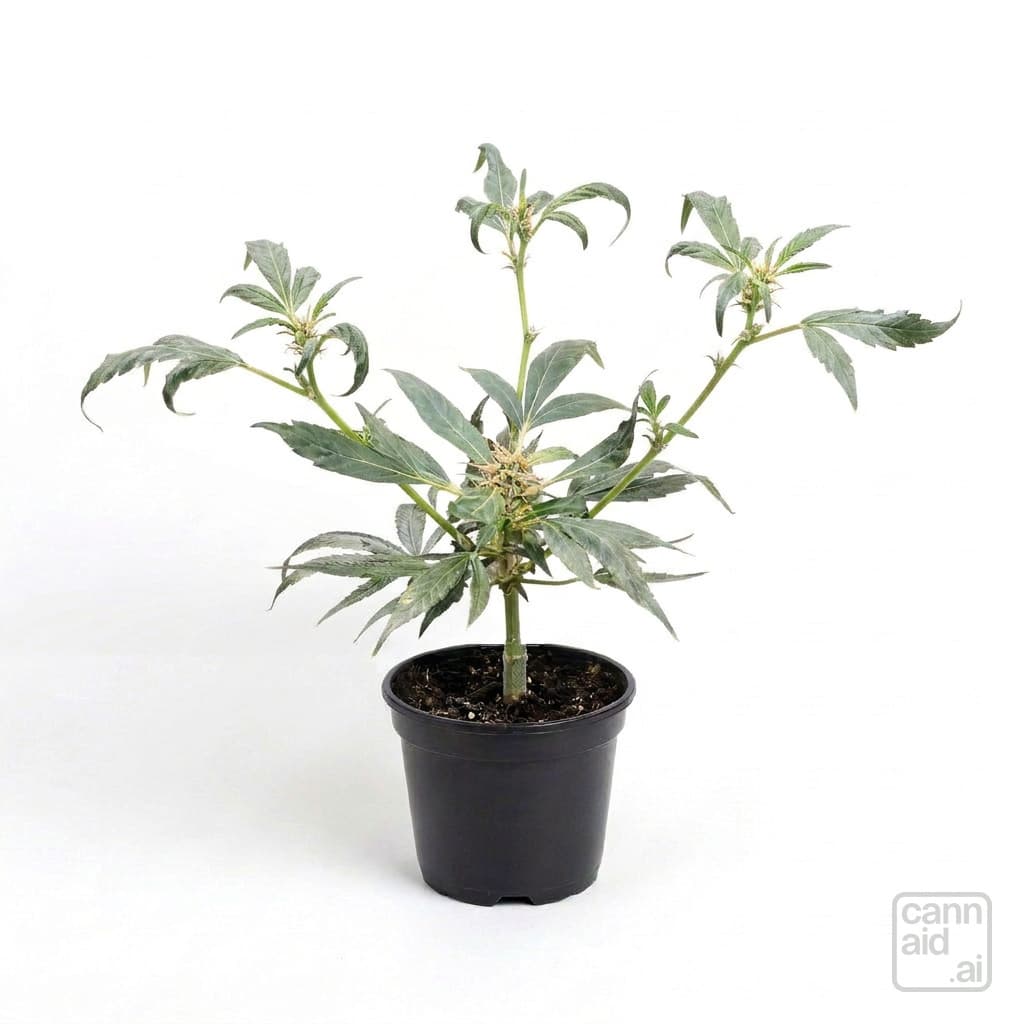
Before you touch the lights, find the fault. Zip yourself into the tent with its lamp off and the room lights on. Wait until your eyes adjust, then cover every point of light you see. Check the timer against a clock. Tape over the indicator. Then decide, and the decision is the plant's as much as yours. Re-flip her to twelve hours at once, and she stalls for two weeks or so. The plant comes back to flower a little bushier, with leafy buds you will trim through. Or let her finish reverting, back onto normal leaves, and flip her a month later. Then the second flowering starts from a wider, stronger frame. What you must not do is push her back and forth. A plant told twice in a month that the year has turned is under exactly the stress that turns a female into a . A reveg that ends in nanners is the worst of both.
On purpose — the second youth
Now read the same fact as a gift. A plant that walks back into veg when the nights shorten will do it after harvest too, if you leave her enough to walk back with. Harvest at ripeness as you would any plant: the top two-thirds, the colas you grew her for. Then stop. Leave the lower third standing. Keep the small buds you would have called popcorn, and every and sugar leaf you can bear to leave. Leaf is how she will feed herself back. Put her under eighteen hours the same day. Change the feed from bloom to grow, with leading again: the green hunger the feeding article describes. A plant weaned off nitrogen for months is about to need it more than ever.
Then wait, and know what waiting looks like. For two weeks, sometimes six, nothing happens that you can see. The remaining buds sit and the leaves hold, and a grower who does not know better pulls the plant for dead. Then the single blades come, twisted and strange, at the tops of the old buds and from the nodes below them. Then three fingers, then five. Somewhere around the seventh week she is a vegetative plant again, but a different one. The plant sits on a root ball a season deep, and every old bud site has become a branch. So the second plant is wider and denser than the first one grown from seed, with a structure you would otherwise have had to top and tie for. The second run takes about as long as a fresh would. What it gives you is the plant you already know, without keeping a .
The same trick works on a cutting, and growers have a name for it. Take clones in the second or third week of flower, from the lower branches, where the flowers are least developed. Root them under long days, and each one reverts in the pot. First the stall, then the single leaves, then a squat, many-branched plant with the same borrowed structure. That is a monster crop: bushy without a single cut. It is the only way to clone a plant you have already flipped when no mother is in reserve. It roots slower than a veg cutting and settles slower, and it repays both. Neither trick works on an autoflower. Her clock is age, and no length of day turns her around. What looks like reveg on an auto is stress, and the only answer is to ride it out.

Reading her
Three things are mistaken for reveg every week on every forum, and one thing is reveg. Read the newest growth: where it comes from, and what its edges are doing. Look at the top of the bud, not the bottom of the plant, and count fingers.
What to do — the flip, the cut, and the wait
Which direction you are in decides everything, and so does the week. A plant reverting by accident early in flower can be put back with little lost but time. Fix the dark, flip her, and trim the leafy growth out of the buds as she resumes. A plant reverting late is another matter. A bud that has started turning will not fatten again. So take what is ripe, and keep the rest on the plant under twelve clean hours. A smaller finish beats a fight that ends in seeds.
The deliberate directions ask for patience above all. The second harvest leaves the lower third standing. It gets long days and nitrogen, then weeks in which nothing happens. The monster crop is the same wait in a smaller pot. Both are decided by how much you love the plant, not by arithmetic. A clone from a mother is faster and simpler, but you have to have kept the mother. And if the plant shows leaves you cannot name in these weeks, the survey reads a reverting plant from the leaves alone.