
Training: When the Grower Bends the Node
Bend her, top her, crush a branch, or fence her in: four ways to shape one plant, and when to leave her alone.
What you'll learn
- Why she grows a spire, and why every training technique starts at her growing tip.
- The four techniques in the order you use them, and how many days each one costs her.
- How a screen turns one plant into a level canopy of even colas, and when to flip it.
- When to leave her alone: autoflowers, a plant already under stress, and anything past the stretch.
Left to herself, a cannabis plant grows a spire. One crown at the very top claims the light, and everything below it lives in that crown's shade. The plant makes one fat on top and a ladder of smaller and smaller ones beneath it. The lowest branches carry buds so loose and airy that growers have a word for them: popcorn. A sativa builds her spire tall and reaching. An indica keeps hers short and dense. Both shapes are taking orders from the tip.
That tip is the whole story. The growing point at the top of the main stem sends a hormone, , down the stem. It also takes the lion's share of the sugar the leaves make. While the tip holds both, the side shoots below it wait. Every technique in this article is one argument with that tip: the bend, the cut, the crush and the screen. Break its hold, and the plant wakes the branches that were waiting. Four ways of saying one thing, and she gives all four the same reply.
What you win is a table instead of a spire. A wide, level lets a dozen colas ripen in the same light and finish together, and that is where the heavy, even harvests come from. The price is paid in days. Each technique slows her for a while, from an afternoon to about a week. Push too hard or too late and she stalls, and the stress can even make her throw male flowers into her own buds. Knowing how to bend a plant is half the craft. Knowing when to leave her alone is the other half.
At a glance
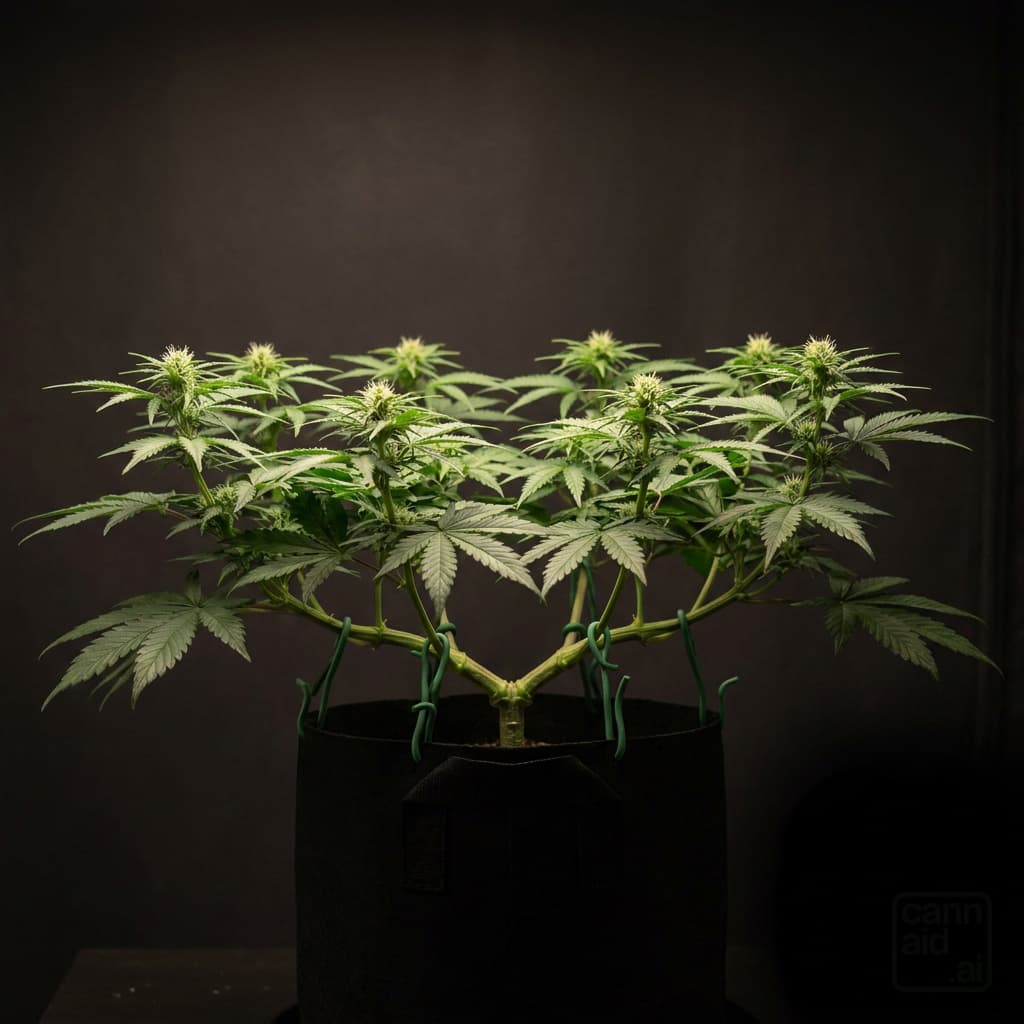
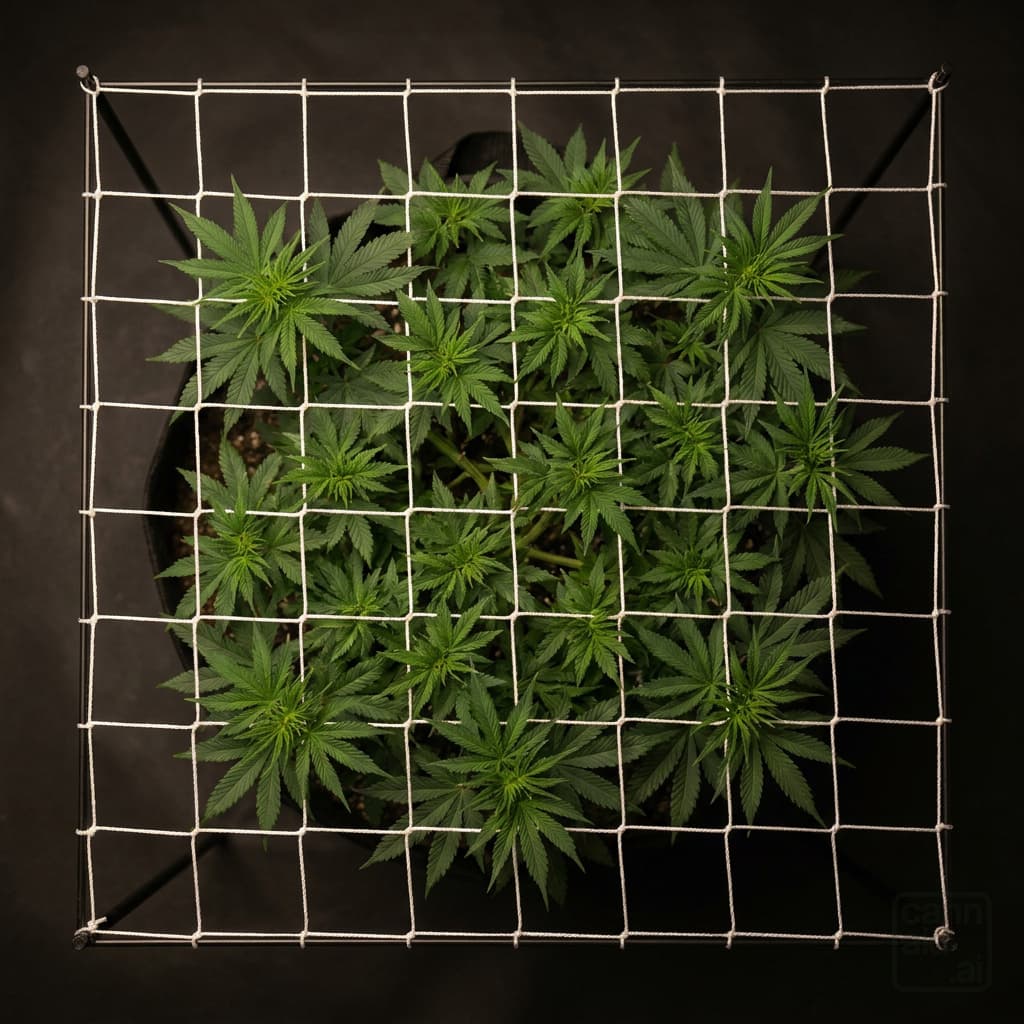
Untrained, a plant grows one tall crown over a ladder of smaller ones. The photo shows the other shape, after training: a low, wide table of tops, all at one height. Every technique below is a way from the spire to the table, and each one has a price. The bend costs her almost no time, but it costs you your attention every few days. The crush costs her a day or two, and the cut a few days to a week. Both give you back a frame that holds its own shape. The calendar at the end holds the exact numbers.
The four techniques
The four rows follow the order you use them in a grow. The bend comes first, and it asks for nothing but your hands every few days. The cut comes early and makes two crowns of one. The crush comes later, for whatever outruns the rest, and it leaves a stem that holds itself up. The screen asks only for patience, and it is the fence the other three were building toward.
LST — the bend that costs her nothing
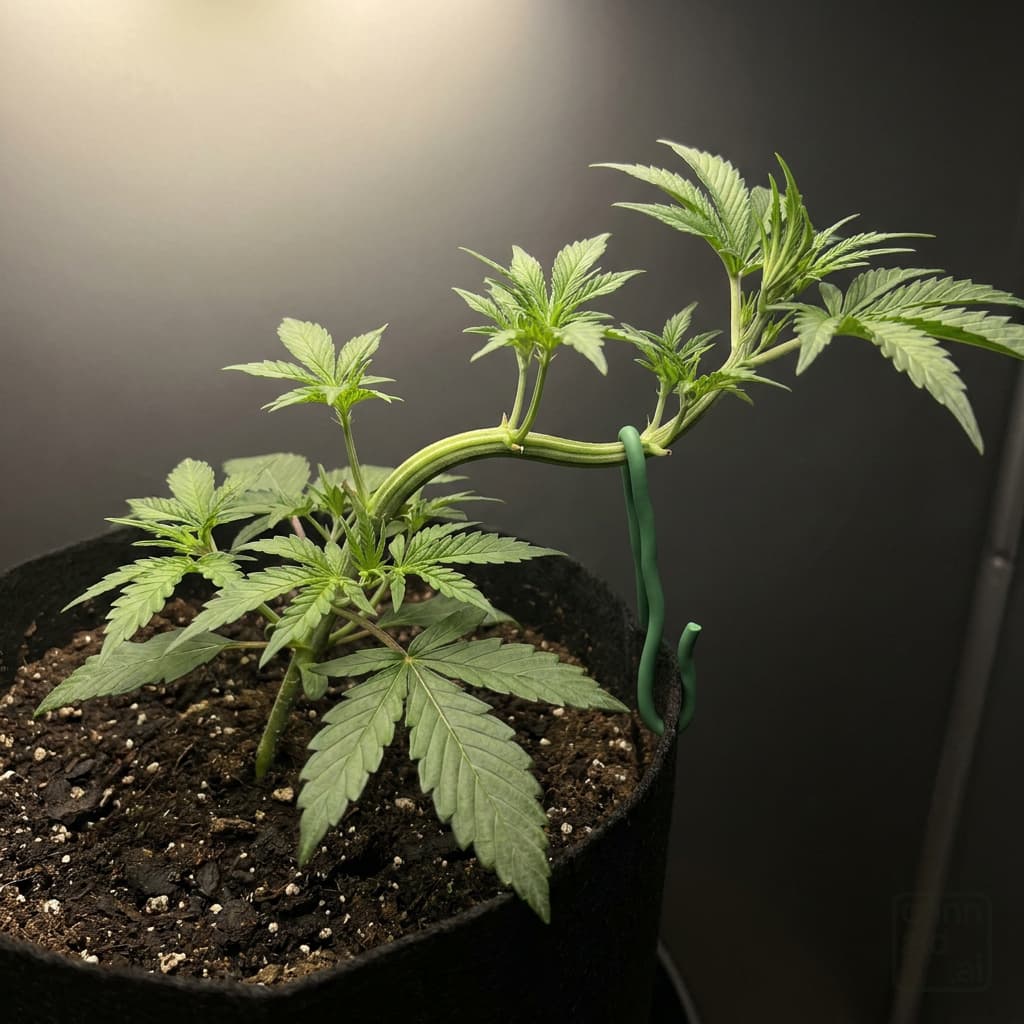
is the gentlest technique there is, and the oldest: you tie the tip down. Start when her main stem has four to six and is still green and supple. Bend it slowly toward the rim of the pot until it lies almost flat, and hold it there with a soft tie or a hook at the rim. Nothing is cut and nothing is bruised. What changes is where the hormone goes. sinks to the low side of a stem laid on its side. The shoots along the top, out of the tip's shadow at last, stand up and reach for the light. Each one grows as if it were a crown of its own.
She answers the bend with barely a pause. Bend the stem in the morning, and by evening the tip has turned back toward the light. There is no wound to close and no crown to regrow, so she barely slows down. That is why it is the only training an should get: she runs on age, not light, and has no days to spare for healing. Through veg, keep at it. As each new shoot rises, lay it down too, working around the pot until the plant is a low, wide hub of even tops. When she after the flip, go on laying the tallest tops down, gently, through the first two weeks of flower.
The price is your attention, not her time. A tied plant needs re-tying as her stems thicken. A tie you forget becomes a wire, cutting into a stem twice the width it was. Bend when the plant is warm and well watered, because a thirsty stem snaps where a full one bends. If you hear the faint crack of a stem giving, stop and tape it. The crush row below explains why it will most likely be fine. Where topping asks the plant to heal, the bend asks only that you keep coming back.
Topping — the cut that makes two of one
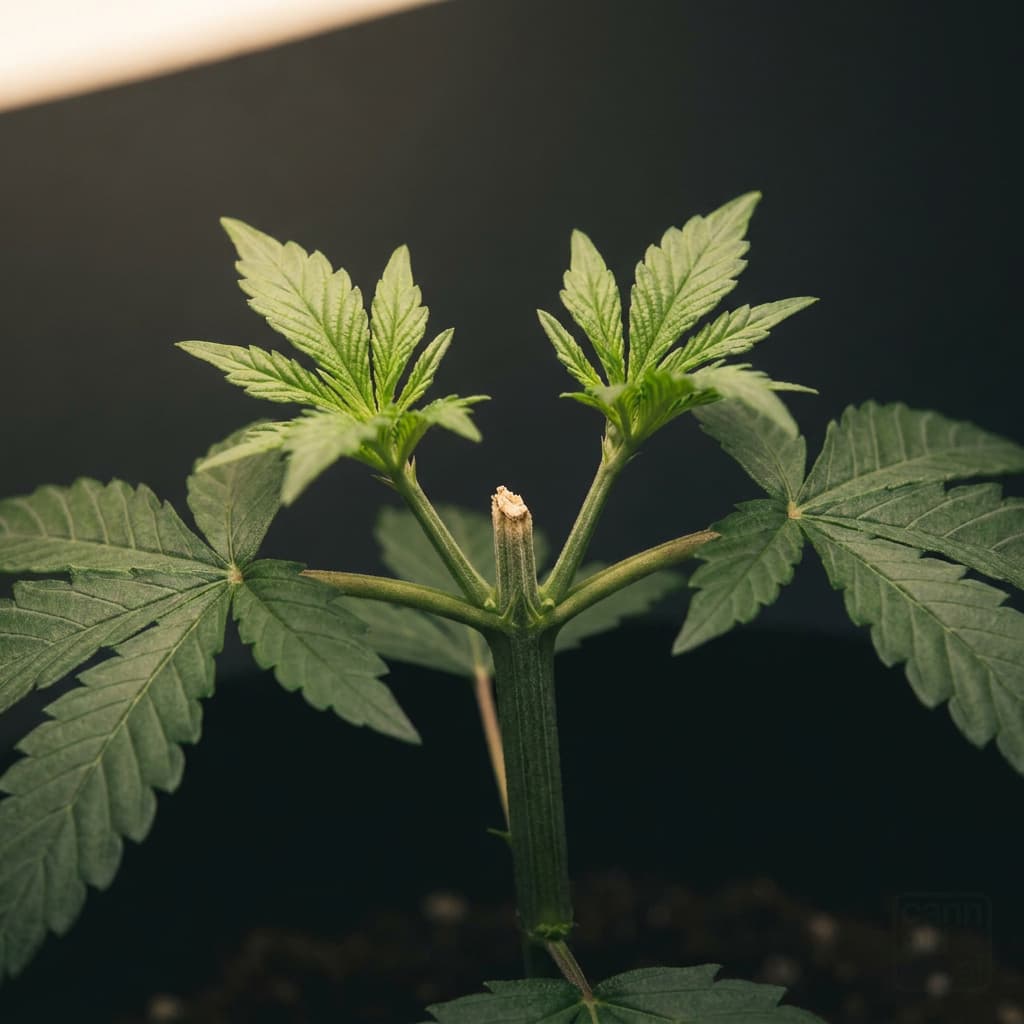
breaks the tip's hold with scissors. When she has four to six nodes, cut the crown clean off above the highest pair of leaves you mean to keep. Tucked into that node are two dormant shoots, the axillary buds, waiting there since the leaves beside them opened. They wake and become two crowns where there was one. The reply is the same as to the bend, only forced. With the tip gone, the sugar it was eating flows to the buds below, and nothing is left to say wait. The pair grows up as equals. Every further top doubles the count again: two into four, four into eight. The disciplined version is the manifold. It strips everything below the split, so every cola rises from one symmetrical hub and no branch is favoured over another.
The cut is paid for in days. For a few days to a week she grows slowly, while the wound seals and the two new crowns take over. No other technique here slows her for as long. Top only a plant that is healthy and growing fast. Never top one that is freshly , hungry, or fighting pests. Make your last cut a full fortnight before the flip. A plant that enters early flower with its new tops still settling enters it short of branches and short of time. The bend can go on into the stretch, but the cut must be over well before the lights change.
There is also the cut done imperfectly on purpose. Growers call it FIM, a name that began as a missed top. It takes only the upper three-quarters of the tip and leaves a ragged stub of the growing point behind. From that stub come not two crowns but usually four, and sometimes only two or three. It costs fewer days than a clean top, because less was taken, but it gives you less say in what comes back. A top is a promise of two; a FIM is a handful of dice. If you want to try it, pinch the tip between finger and thumb rather than cutting, and let whatever rises decide the plant's shape. Either way, the rule after any cut is the same: leave her be until she grows again.
Supercropping — the crush that heals stronger
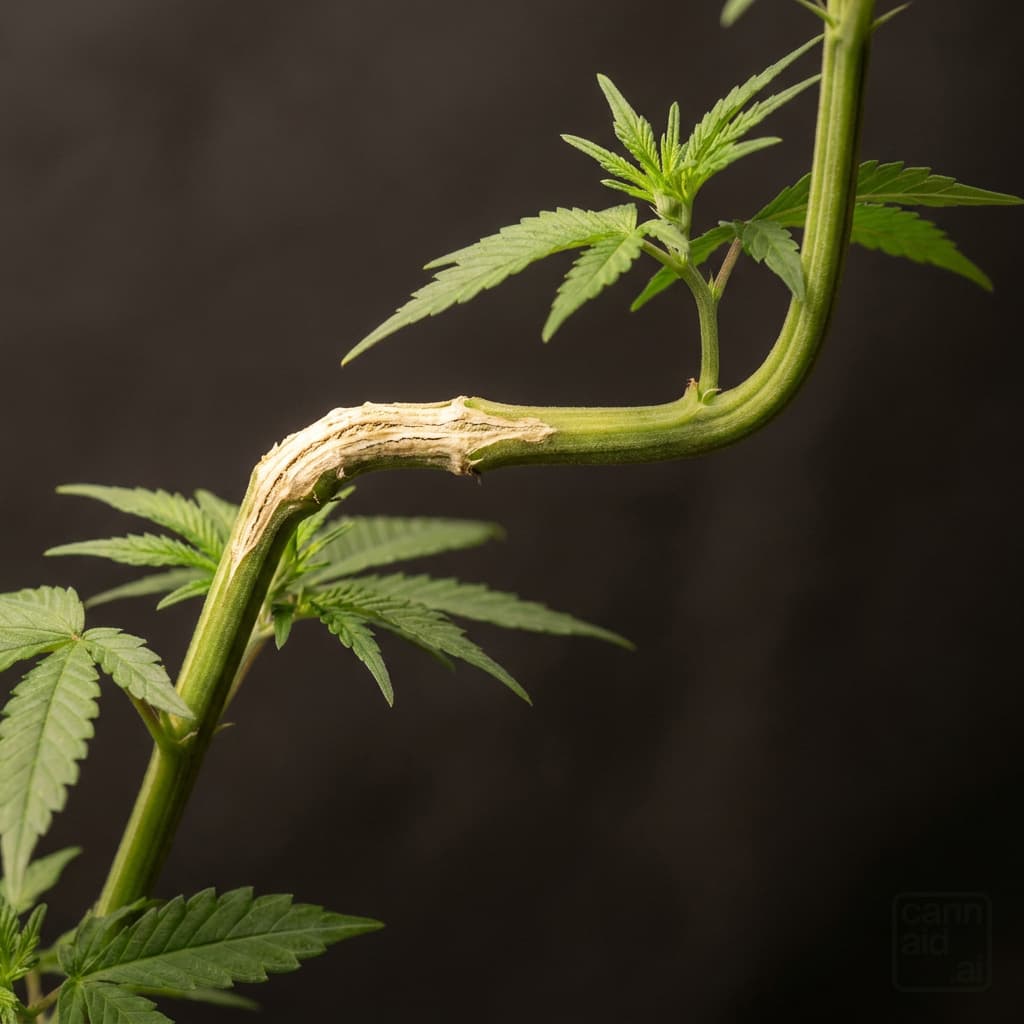
Supercropping is done with your fingers. It looks like the roughest technique here, though it costs less time than a cut. Choose a branch that is outrunning the rest, and find a soft green length of stem a hand's width below its tip. Roll it firmly between thumb and forefinger until the inside gives: the pith and the vessels crushed, the skin unbroken. Then fold the branch over where it has gone soft. It flops. Within a day its tip has turned back up toward the light. Over the next week or two the bend swells into a hard knot that growers call the knuckle, thicker than the stem on either side. Her wound becomes her brace.
It is by name and by nature. The plant loses a day or two: more than a bend costs, and less than a cut. But it buys two things the bend cannot. A crushed branch stays where you put it once the knuckle sets, with no tie to check and no wire to forget. And it is the one hard technique you can still use in the first two weeks of early flower. Sometimes a cola in the stretch is about to meet the light, and there is no room left to raise the lamp. A crush lays it over in an afternoon, and it stays down. A cut there would cost her a bud.
The failure is the snap. Bend a stem you have not softened enough, or one gone woody, and the skin tears until the branch hangs by a thread. Even then, the branch is usually not lost. Line the two halves up and wrap the break in tape. Splint it against a stake if it needs one, and leave the tape on for two weeks. A taped break heals the way a knuckle does, and a branch that looked finished can still carry flowers at harvest. But treat that as the rescue it is, not the plan. The crush is for a plant that is healthy, green and growing. On a stressed plant, or a stem past the stretch, it breaks more often than it bends, and the added stress can push her to throw pollen sacs.
SCROG — the fence around the canopy
The is not a wound at all. It is a fence: a net of squares stretched about a forearm above the pot. Every branch that rises through it is laid back down and tucked into the next square over. The plant fills the screen sideways before she is allowed to grow up. Each tuck is a small bend, answered with barely a pause. What the screen adds is a rule the plant cannot outgrow. LST makes a hub, and topping makes crowns. The screen makes a level: every cola that finally rises through it starts at the same height and meets the light on the same terms.
The work is in the filling. Through veg, tuck every day or two, guiding the tips toward the empty squares at the edges. Top or bend the plant first, so there are enough branches to spread. One plant can fill a screen alone, but she takes her time. Several plants fill it sooner. The whole method turns on one decision: when to flip. About three-quarters full is the moment, because the stretch of early flower will fill the rest. A screen already full at the flip is a canopy about to grow past its own light. Keep tucking through the first two weeks of flower, while the stems are still supple. Then take your hands away for good. A branch stiffening into bud does not bend. It breaks.
Below the screen she keeps trying to grow, and nothing down there is worth the effort. Those shaded shoots would only ripen into popcorn. In the last week of veg, growers strip that undergrowth away, a clean-up they call lollipopping, so everything she has goes to the level above. The screen repays the most patience and asks the most veg time. That is why it belongs to plants: an autoflower runs out of time before a screen can fill. Read the four rows together and they make one plan. Bend her, top her, crush whatever outruns the rest, and fence the lot. Each step is the same argument with the same growing tip, made a different way.
When to leave her alone
Training is stress, and stress is a budget the plant keeps whether you count it or not. A healthy plant in the middle of veg has plenty to spend. She is growing again within a week of a cut, lifts a crushed branch within a day, and shrugs off a bend by nightfall. But every , every transplant, every hot afternoon and every pest draws on the same account. A plant already spending it on a shortage has nothing left over for training. So the question is never whether she can take it, since a healthy plant can take almost anything once. Ask instead: what else is she paying for this week?
The other limit is the clock. Every technique needs the plant to grow afterward, and a plant that has stopped growing cannot answer. Autoflowers stop on their own schedule, so the only technique they can afford is the one that costs no days. Any plant stops building its frame a fortnight or so into flower, when the stretch ends and the stems harden into bud. After that, a bend breaks. A crush is stress she does not need, the kind that can push a flowering plant to turn and seed her own harvest. The rest is temperament. A sativa reaching for the ceiling asks to be bent, and bent again. A squat indica may need one top and little more. Know which one you are growing, and ask her for less than you think.
The training calendar
Every technique has a week it belongs to, and a week it becomes a mistake. This table shows when each one begins, when it continues, when to take your hands away, and how long she pauses after each. It holds the numbers the prose above left out.
| When | LST | Topping · FIM | Supercropping | SCROG |
|---|---|---|---|---|
| Veg, 4–6 nodes | First bend: main stem down to the rim | First top, above node 4–5 | Not needed yet | Set the screen 40–50 cm (16–20 in) above the pot |
| Veg, after the first top | Bend each new shoot as it rises | Second top once she is growing again, about a week on | Any branch outrunning the rest | Tuck every 1–2 days, tips toward the edges |
| Last week before the flip | Keep bending new shoots | Too late: last top 2 weeks before the flip | Last chance in veg | Flip at 70–80% full; lollipop below the screen |
| Flower, weeks 1–2 (the stretch) | Tie the tallest tops down, gently | Never | Only a cola racing for the light | Keep tucking; the stretch fills the screen |
| Flower, week 3 onward | Hands off | Never | Never: the stem breaks, and she may turn hermaphrodite | Hands off |
| Pause after each | A few hours | 3–7 days; a FIM less | 1–2 days; the knuckle sets in ~2 weeks | A few hours per tuck |