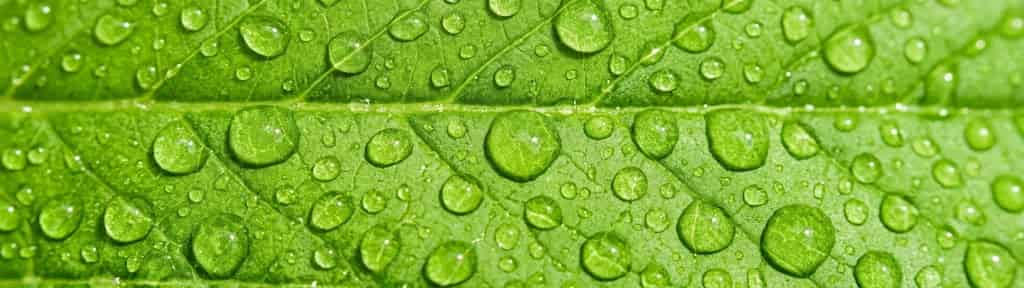
The sharp apex of each leaflet. Tips are the first to burn when light is too close or salts pile up in the root zone — crispy edges starting from here speak of environment before they speak of nutrients.It's the pointed end of each finger of the leaf. Sitting farthest from the stem, it loses water and shows stress first — so a clean, un-curled tip is one of the easiest signs the plant is comfortable.
Anatomy: Of the Cannabis Plant and Its Parts
Getting Started6 min read28 labeled parts
A field guide to the parts you'll come to know by sight.
What you'll learn
- The seven parts of a single fan leaf — and which ones tell you about nutrients, and which about weather.
- The structural language of a young plant — stem, node, and internode — and what each one is trying to tell you.
- How to read a male plant before his pollen ever drops.
- The vocabulary you'll need to read the rest of this library.
Cannabis is a wind-pollinated annual with separate male and female plants — what botanists call dioecious — and three lineages that grew up in three very different corners of the world. Sativa comes out of the equatorial sun of Southeast Asia and Africa, her leaflets long and narrow. Indica comes down from the cold high mountains of Afghanistan and Pakistan, broad-leaved and dense. Ruderalis comes from the cold steppes of Russia, small and stubborn. Modern botany counts them all as subspecies of one plant — Cannabis sativa L. — but the old names persist because each lineage still wears its own silhouette.
Different as they look from the outside, every cannabis plant carries the same parts inside: the same fan leaves with their saw-toothed leaflets, the same nodes and internodes along the stem, the same bracts cradling the same flowers. We've used the indica form as our visual baseline throughout this guide — she's the silhouette most growers will meet first. The parts she carries are the parts they all carry.
Almost every diagnosis you'll ever make begins with naming what you're looking at. Yellowing on the lower leaves means one thing; the same color on new growth means quite another. Pests prefer the underside of leaves, mold settles in dense flower clusters, and light burn lands on the tips of the canopy. The faster you can name a part, the faster you can act.
What the Plant Is Made Of
Walk up to any cannabis plant — sativa, indica, ruderalis, or anything bred from a mix — and you'll meet the same architecture. The differences live in the spacing.
Indica Plant
Stand beside an indica and the word you reach for is compact. Her doesn't match a sativa's reach — outdoors she rarely passes two meters, indoors she usually stays under one — but what she lacks in stretch she more than makes up for in build. The trunk thickens early and the firms up before she ever sets a flower, because she has to hold up a heavier flower mass per inch of frame. Each meets that trunk at a , and the bare stretch of stem between two nodes is an . Indica wears her internodes short — typically two to four inches between nodes, side branches pressed close in tiers, the whole plant building into a bushy column rather than reaching for the sky.
This is geometry bred by the cold high mountains of Afghanistan and Pakistan, where summer is brief and autumn arrives without warning. A plant up there can't afford the luxury of a long stretch; she has to ripen in seven to nine weeks of flower, hoard her energy into dense buds, and pack the most resin she can into the smallest, sturdiest frame the mountain will allow. The thick coat of trichomes she's famous for is the same answer to the same question — the high-altitude UV would burn anything less.
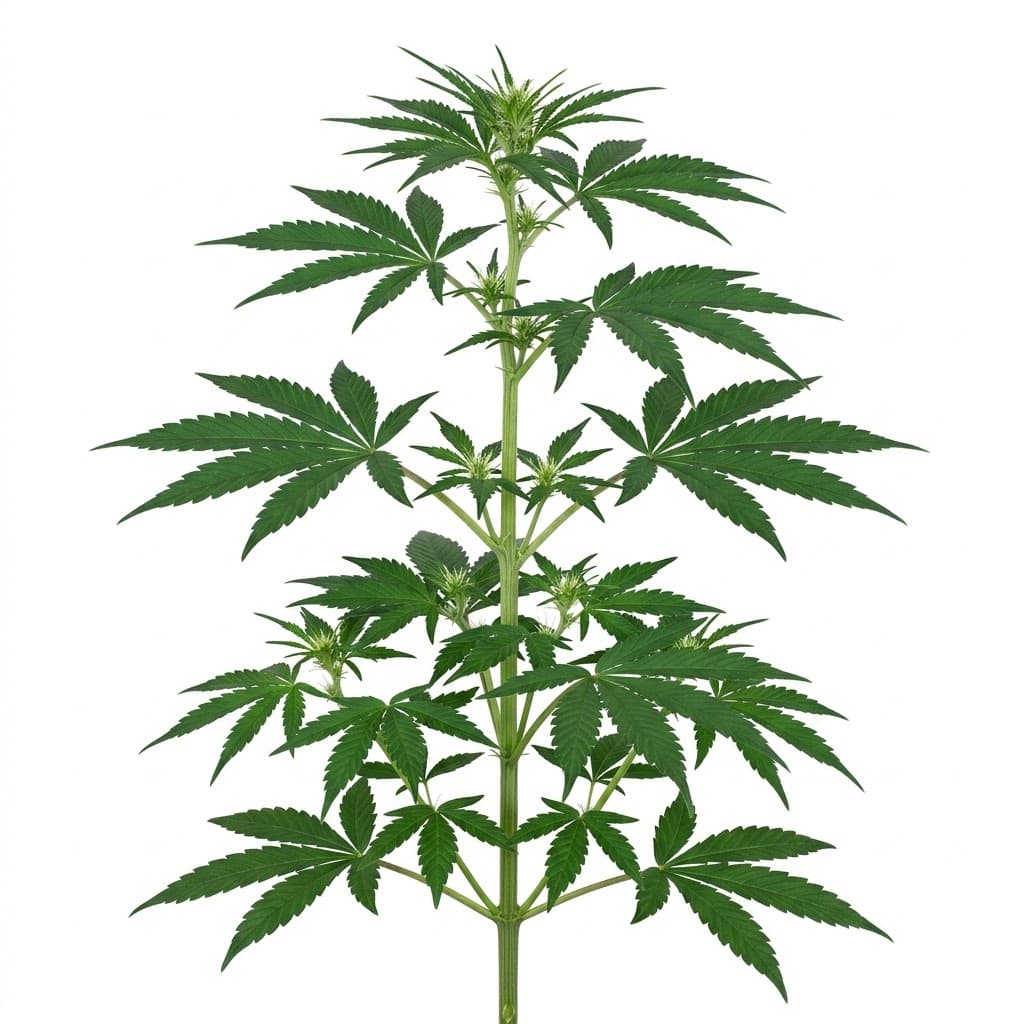
Sativa Plant
A sativa, by contrast, was built for the long warm year. Her — the growing tip at the crown of her — pushes upward without rest, lifting the canopy three meters or more in a season; outdoors near the equator she can reach the height of a small tree, and indoors she still demands a tall room or a heavy hand with training. Her stem is fibrous rather than woody, which is why a strong wind will lay her flat if no one has tied her up. Her stretch long too — five to eight inches of bare stem between every pair of — so her sit far apart, where indica's would be stacked. Her — the big, palmate sun-collectors at every node — follow the same rule: spaced wider on her frame than indica's, narrower in the leaflet, lighter in green, and fewer of them per foot of stem.
The whole architecture is a reply to a different climate. Sativa grew up near the equator — South and Southeast Asia, equatorial Africa — where the sun is steady and the year never quite ends. A plant there has the luxury of time: she can spend three months stretching, two more flowering, and let the season carry her. The effect is bright and uplifting; the cost is a longer wait. Most pure sativas don't finish in under ten weeks of flower, and the slowest will run sixteen.
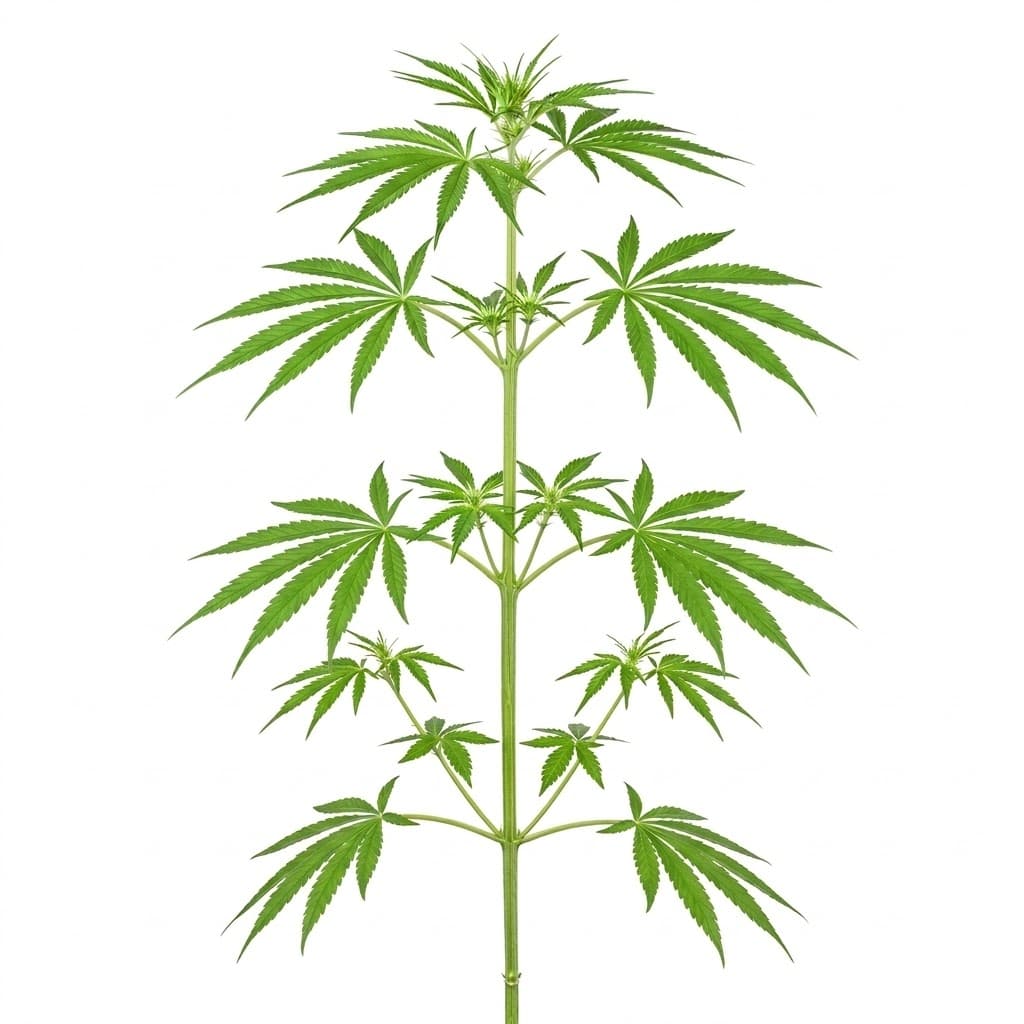
Ruderalis Plant
Ruderalis is the smallest of the three by a wide margin. A mature ruderalis tops out at thirty to eighty centimeters — knee-high at her best, ankle-high at her humblest — with a short sturdy that puts up only a handful of . Her are short by necessity, but they sit a little irregular — sometimes pressed tight, sometimes leaving an awkward gap — as if the wild ancestor in her never quite settled on a rhythm. Her leaves are smaller too, only three to five to a , and each leaf attaches to the stem through a short — the stalk that fastens the whole leaf to the stem. As she nears flower, the first appear at her upper , small leaf-like sheaths that will later cradle her seeds. By any measure of size, yield, or potency she is the runt of the family — wild ruderalis rarely climbs above one percent THC.
And yet she is the most important parent in modern cannabis breeding. Ruderalis grew up on the Eurasian steppe — Russia, Siberia, Eastern Europe — where the summer is short and the latitude too high for a reliable photoperiod shift. A plant up there can't wait for the days to shorten to start flowering; by the time they do, the snow is already on the way. So ruderalis evolved to flower by age rather than by light: when she is old enough, she flowers, regardless of what the sun is doing. That single trait — autoflowering — is why every modern auto strain on the market traces back to her. A Russian botanist named Janischewski first described her in 1924 from plants gathered along the Volga, and she was an obscure curiosity for most of a century until breeders realised what her one strange habit could do.
What the Leaf Is Made Of
Three lineages, three slightly different leaves. Same parts on every one — count them once, recognise them anywhere.
Indica Leaf
Hold an indica leaf flat in your palm and the first thing you notice is how much there is. Each finger of the fan is a leaflet — five, seven, or nine of them in a palmate arrangement, open like a hand, with the central leaflet always the longest. Indica leaflets run broad and stout, deep forest green, with coarse saw-toothed serrations down their edges. Running up the centre of each leaflet from base to tip is the , the thick central vein that holds the blade rigid even when the rest of her hangs limp from thirst.
The shape is the same answer to the same question as her stem. The mountain summer is bright but short, and a plant that wants to ripen in seven to nine weeks needs every photon she can catch — so she packs her chlorophyll into broad, flat surfaces and holds them up to the sun. The dark green is the chlorophyll itself: more of it per square inch than either of her cousins.
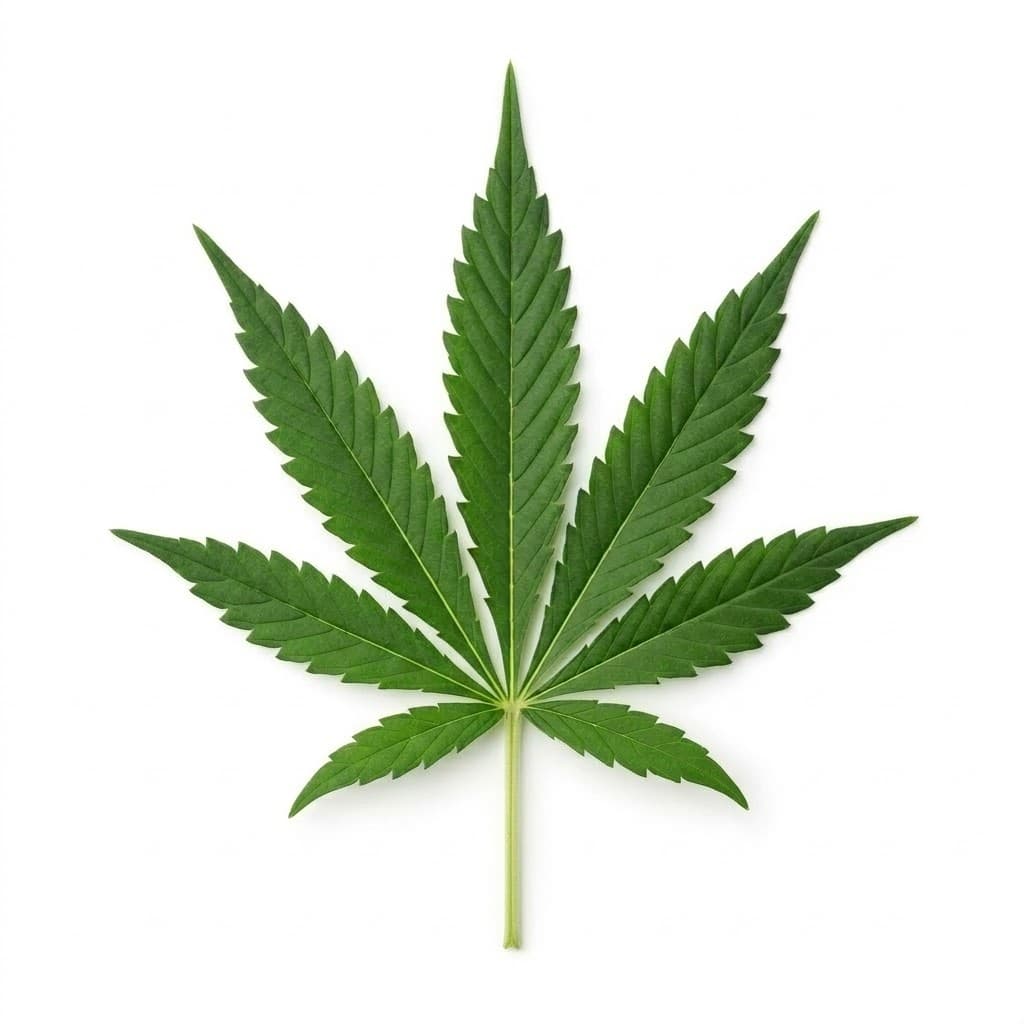
Sativa Leaf
A sativa leaf is the opposite study in shape. Where indica builds her broad, sativa stretches hers long and narrow — seven, nine, sometimes as many as thirteen leaflets per leaf, each one a slender finger almost wispy by comparison. Her tapers to a sharp point that gives the leaf its jagged, almost spiky silhouette; tips are the first thing to burn when light is too close or salt builds in the root zone, so this is the part a sativa grower learns to watch. Between the and the , smaller branch off at angles, and it's the tissue between those veins that yellows first when she's hungry for iron or magnesium.
The green is lighter too — less chlorophyll per inch of leaf than indica, because she doesn't need it. The equatorial sun is intense and steady year-round; her thin leaflets shed heat better than indica's broad ones, and the gaps between them let light pass through the canopy to reach her lower foliage. A sativa works the year long; she trades depth for breadth, and lets photosynthesis run wide instead of dense.
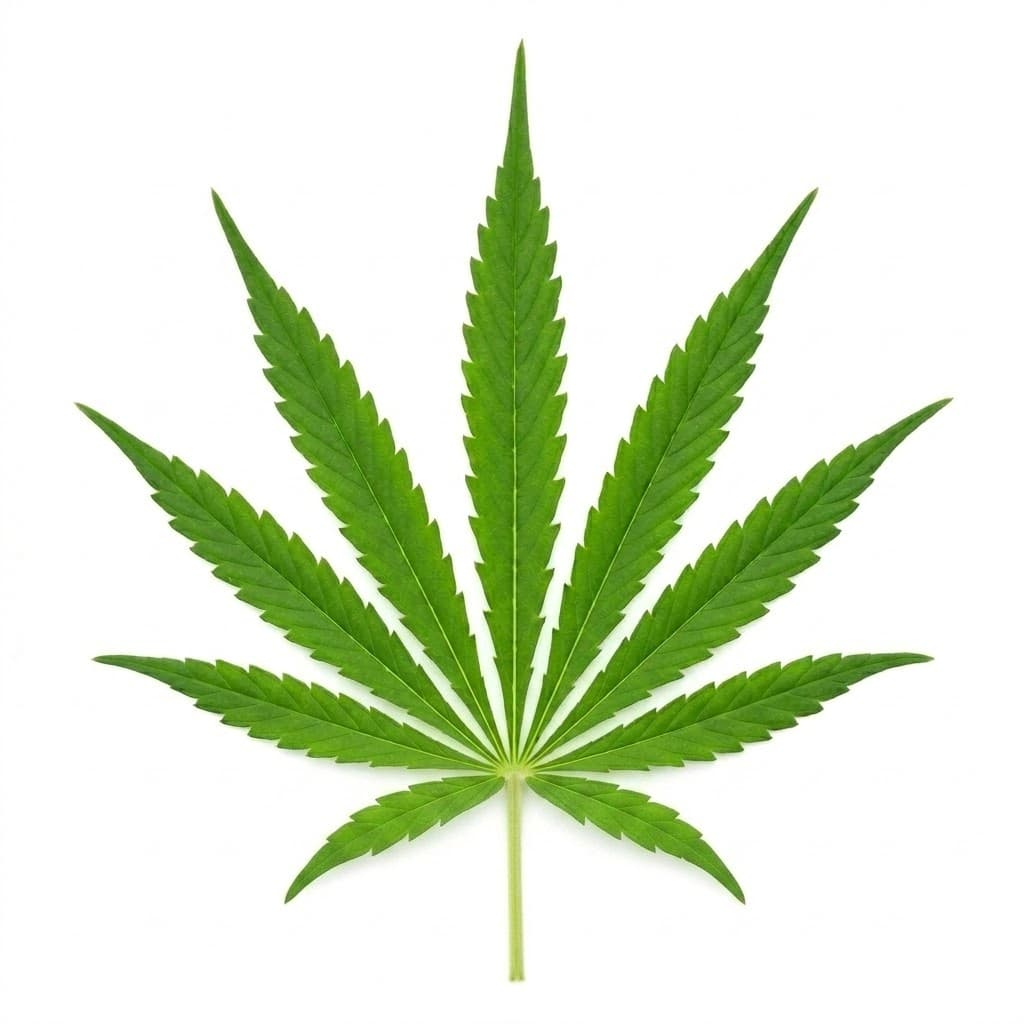
Ruderalis Leaf
A ruderalis leaf is what you get when you ask the same plant to make a leaf in half the time. She carries only three to five per fan — sometimes mistaken for a young sativa leaf, but smaller and rougher around the edges, with shorter blades and more space between them. Trace the perimeter of any leaflet and you'll find the , the saw-toothed edge where potassium hunger draws its first brown line. Where all the leaflets converge sits the , the join that calcium hunger will narrow first on her youngest leaves.
She does less with what she has, and she does it on purpose. The leaf is smaller because the whole plant is smaller; she has weeks rather than months to build her solar collectors, and she'd rather make many small leaves quickly than a few large ones slowly. Each leaf attaches to the stem through her — the same stalk every cannabis plant carries, just shorter and finer on a ruderalis. Nothing about her foliage is impressive on its own; everything about it is built for speed.
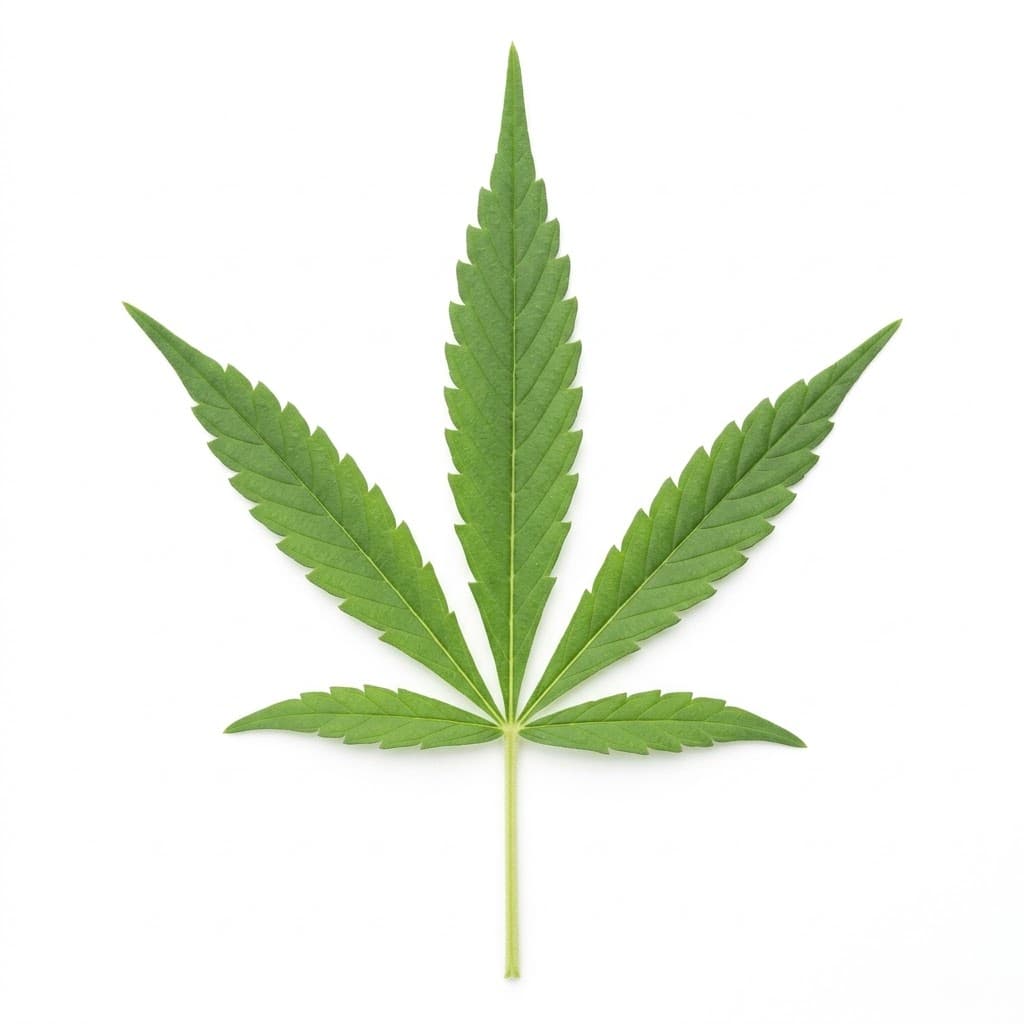
The Fan Leaf
One mature leaf — her solar panel, and the first surface you'll learn to read.
The thick central running from base to tip of a leaflet. When a leaflet is parched, the midrib stays stiff while the blade goes limp — a quick way to tell thirst from heat.Think of it as the leaflet's spine — the central rib that carries water and structure out to the tip. A leaf that folds or canoes along this line is usually telling you about heat or watering, not a nutrient problem.
The smaller veins branching off the midrib. In iron and magnesium hunger, the tissue between these veins yellows first — the veins themselves hold their green a while longer, leaving the leaf with a striped look.Picture the side branches of the leaf's plumbing, fanning out from the midrib. They matter because the pattern around them — veins still green, the tissue between them pale — is one of the clearest ways to read a deficiency straight off a leaf.
Each finger of the fan leaf is a leaflet. A mature cannabis leaf wears 5, 7, or 9 of them in a palmate arrangement — open like a hand. The flat surface is where she catches her light and makes her food.In everyday terms, a leaflet is one finger of the hand-shaped leaf. Together they're the plant's main food factory, turning light into sugar — which is why broad, outstretched leaflets are such a simple sign she's thriving.
The saw-toothed edge of each leaflet. Potassium hunger starts here — the very tips of the serrations brown and crisp before any change touches the body of the leaf.It's simply the toothed outline running around each leaflet. Because the edge sits farthest from the leaf's plumbing, it's often the first place trouble surfaces — browning or crisping there is an early flag worth a closer look.
Where all the leaflets meet the . Calcium hunger narrows this base on the youngest leaves — they grow in looking like skinny, stretched-out fingers.This is the narrow point where all the fingers join and hand off to the leaf stalk. New growth that comes in pinched or strappy here is a classic early sign the plant isn't moving calcium well.
The short stalk fastening the whole leaf to the main . Phosphorus hunger tints the petiole purple-red — some genetics do this purely for show, so check the leaf body before you trust it.Simply put, it's the stalk that joins a leaf to the stem — the leaf's neck. It's worth watching because its angle tracks her mood: lifted and firm when she's happy, drooping when water or roots are off.
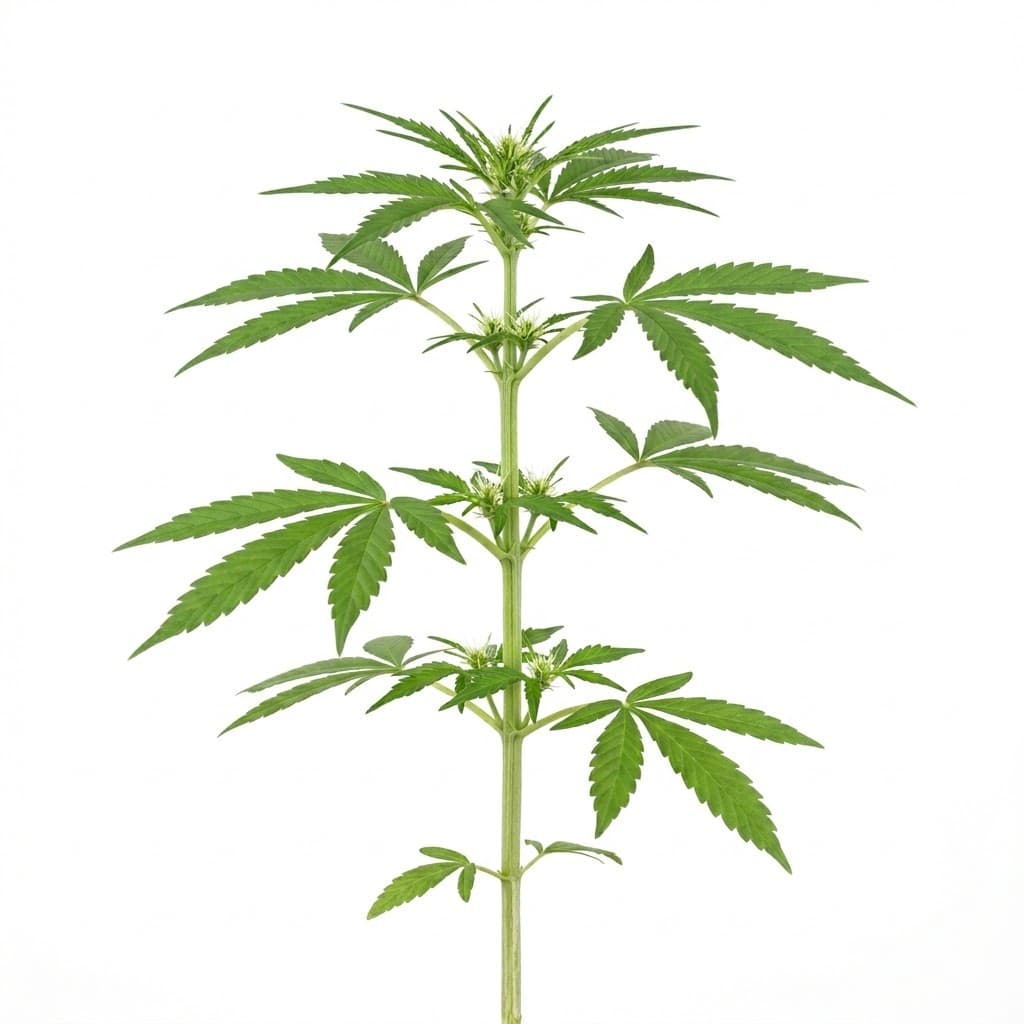
The Plant (Early Flower)
A young female in early flower — the structural language you'll use to describe any plant in this library.
The very crown of the main stem — the source of every new cell, and the place her main will eventually rise. Pinch this point and you force her to spread sideways instead of skyward.In plain terms, it's the plant's main growing tip — the bud at the very top that drives upward growth. It matters because removing it (topping) is the most common way growers trade height for a wider, bushier plant.
The dense cluster of flowers that crowns a branch — and her largest, the main cola, rises from the top of the main stem. The size and weight of the main cola sets the tone for the whole canopy; everything below it tends to finish a few days later and dress out a touch lighter.A cola is just a bud site — a stacked column of flowers running up a branch. The biggest sits at the top, and growing several even-sized colas instead of one tall one is the whole point behind most training.
The small narrow leaves emerging from inside her flower clusters — fewer leaflets than a fan leaf, and coated in by the time she finishes. Bag-worthy material at harvest, whether you trim them off or leave them on.These are the little leaves poking out of the buds themselves, named for the dusting of resin that leaves them looking sugar-coated. Most growers trim them for a cleaner look but keep them, since they're potent enough for edibles or hash.
The point on the stem where leaves and meet. Young cannabis is opposite-branching — two leaves and two branches per node, perfectly mirrored. Sex usually shows here first: pre-flowers for a female, pollen sacs for a male.A node is simply a growth junction on the stem. Growers count them to gauge a plant's age and to time topping or training, and because the lowest nodes carry the first pre-flowers, they're where you confirm whether a plant is female or male.
The bare stretch of stem between two nodes. Tight internodes mean a stocky, compact plant; long, stretched internodes usually mean she's reaching for light she can't quite touch.The internode is just the gap between two of those junctions, and its length is a quick read on health: short, even gaps mean strong light and a sturdy plant; long, stretchy ones usually mean the light is too weak or too far away.
The large palmate leaves that fan out from each node. These are her main solar collectors — leave them be unless they're plainly dying. Stripping healthy ones costs her growth, not gives it.These are the big, classic cannabis leaves — the ones on the logo. They're her main engine for making food, so the rule of thumb is to leave them alone unless they're clearly dead, however tempting it is to pluck them.
The side branches that fan out from each — her secondary scaffold. Each can mother its own smaller in flower. Topping, lollipopping, and LST are all ways of deciding how many laterals reach the canopy with enough light to bear good weight.These are simply the side branches growing off the main stem. Each one can become its own little flowering column, so much of training is about spacing them out and lifting them into the light so more of them bear real weight.
The pair of small leaf-like growths at the base of each , where it meets the stem. Pure botanical artefact — growers rarely look — but one of the small details that confirms you're looking at cannabis and not a lookalike.These are the tiny pointed scales sitting where a leaf stalk meets the stem. They don't do much for the grower day to day, but they're a quick way to tell a real cannabis plant from a lookalike weed.
The dormant growth point tucked at the base of each , just inside the — every and every flower cluster started life here. Topping cuts above an axillary bud to force the two below it to wake up and split into a double canopy; fimming damages the bud directly to coax three or four shoots instead of two.This is the small dormant shoot tucked into the angle between a leaf and the stem — a growth point held in reserve. Training works by waking these up: cut above them and the buds below take over, turning one stem into many.
The central vertical axis of the plant — her trunk. A healthy main stem turns firm and slightly woody at the base by the fourth or fifth week of veg; a floppy stem usually means she hasn't had enough light or wind to grow strong.It's exactly what it sounds like — the plant's trunk, the central pillar everything else hangs from. Its thickness and stiffness are a good gauge of overall vigour, and a strong one is what lets her hold up heavy buds at the finish.
Inside the Flower
A single calyx, up close — stack a few hundred of these and you have a bud.
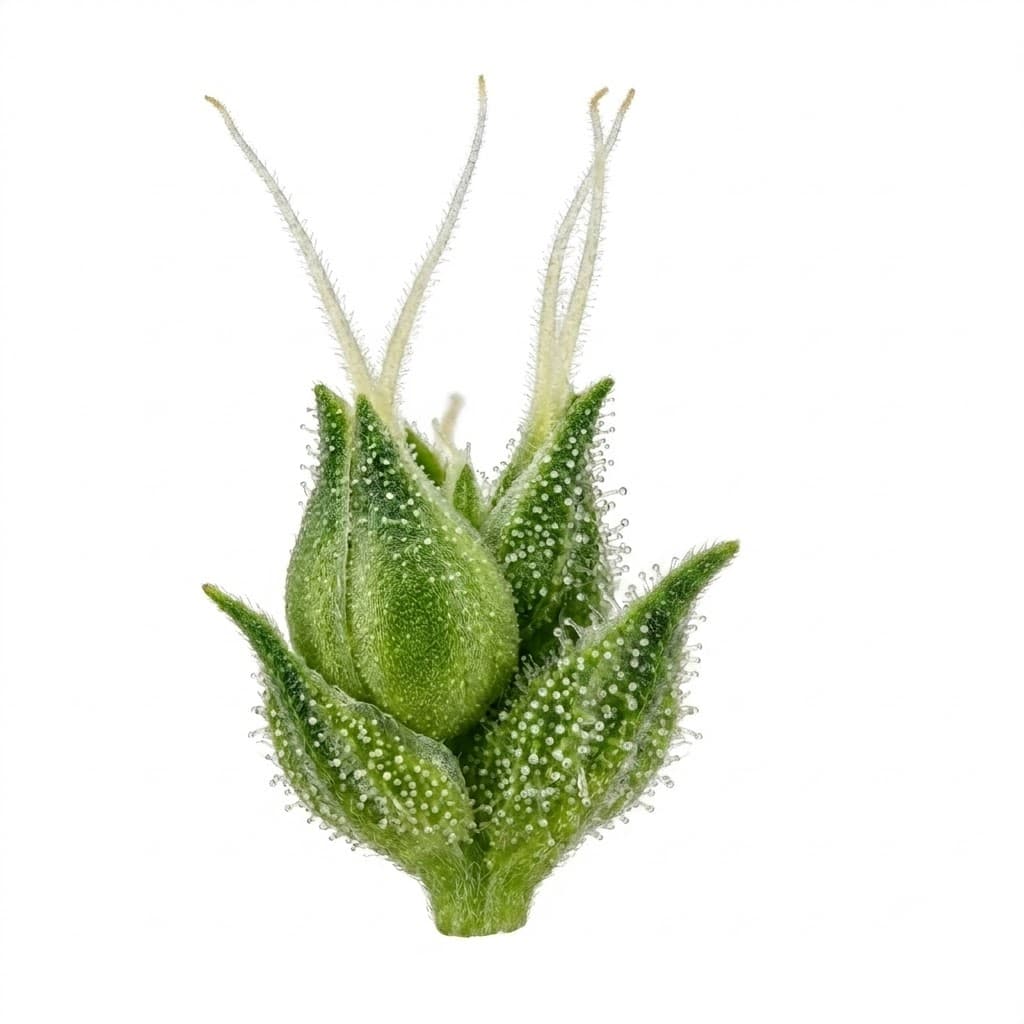
The teardrop-shaped green sac at the base of each pair — the actual reproductive vessel, where most of a flower's weight and resin will eventually sit. On a male the same position holds a instead; same architecture, opposite job.This is the small pod that actually swells into the bud — the part that fills out and gets sticky as she ripens. When growers say buds are fattening up, the calyxes stacking on top of each other are what they mean.
Small leaf-like sheaths that cradle the developing flowers. On a female plant the bracts hold the and bear most of the visible once she's deep in flower.Plainly, bracts are the little overlapping scales that make up most of a finished bud's surface. They carry the heaviest frost of resin glands, so they're a big part of what gives good flower its sparkle and smell.
The thin white-to-peach hair rising from each — her receiver for pollen. As she finishes, pistils turn through every shade of amber and rust; the colour shift is how she signals she's done listening for males.These are the wispy hairs you see all over a bud — the part most people simply call the hairs. Their colour is a handy at-a-glance timer: mostly white means keep waiting, mostly orange-brown means she's getting close.
The receptive tip of the — botanically the actual pollen-catching surface, though most growers use pistil loosely for the whole visible hair. The fresher and whiter the stigmas, the more receptive she still is.It's the sticky, hair-like tip whose only job is to catch pollen. For a grower it's mostly a ripeness clue — bright white means she's still early, while browning, curling hairs mean she's heading toward harvest.
The microscopic resin glands that frost her bracts, calyxes, and in late flower — clear at first, then milky, then amber as they ripen. Watching them through a loupe is the standard way to time a harvest.These are the tiny, frosty, mushroom-shaped glands that coat the buds and make them glitter. They hold most of the plant's THC and aroma, and their colour is the main signal growers use to pick the exact day to harvest.
The Male Plant
Pollen sacs in place of pistils — name the difference before any pollen has had its say.
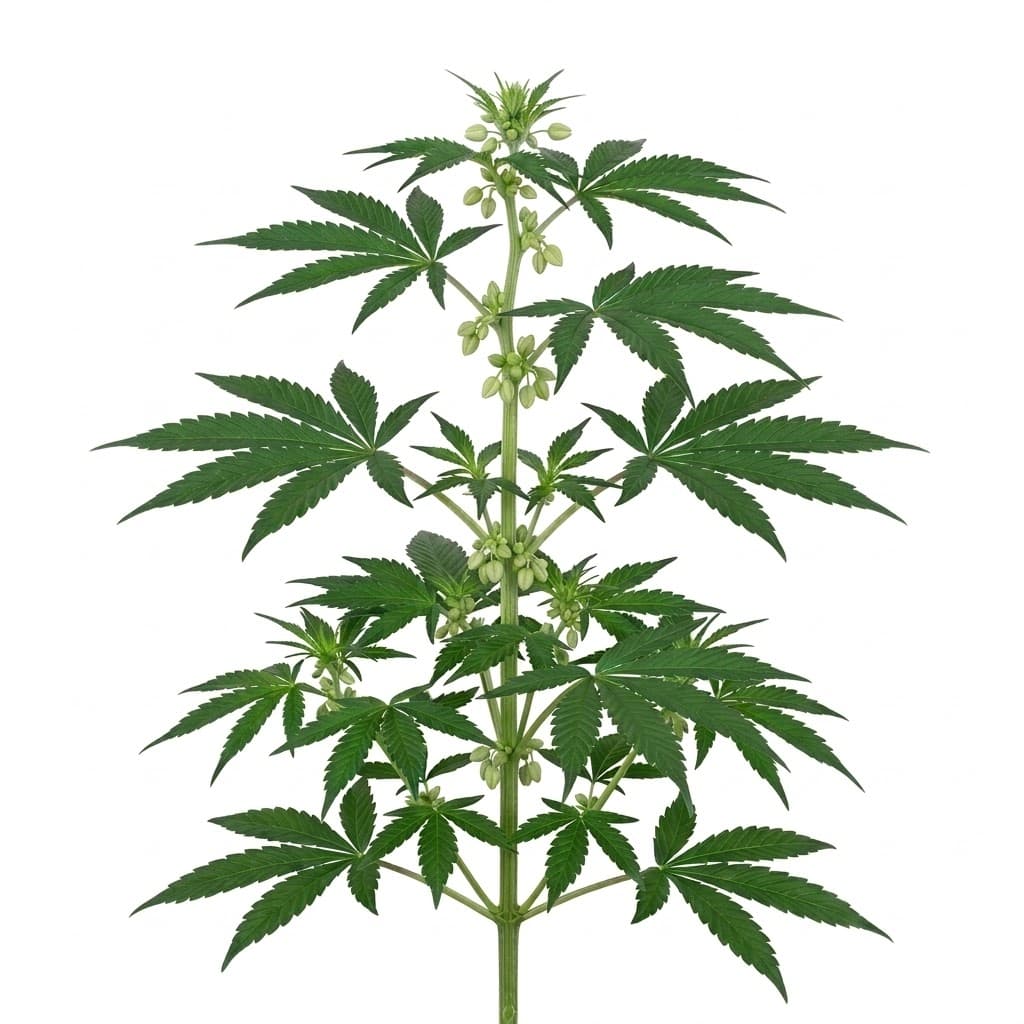
The male flower cluster — a tight bunch of pollen sacs on short stalks. Where a female grows long bracts crowned with two white pistil hairs, a male grows these grape-bunch clusters instead. This is the giveaway.This is simply the male version of a flower — its job is to make and release pollen, not grow bud. Spotting these grape-like clusters early is what lets you remove a male before he pollinates the females around him.
Each oval green capsule is a single pollen sac — formally, an anther. When mature, they split open and let yellow pollen fly on the wind. A single male can pollinate a whole tent in a single afternoon — pull him the moment you're sure.Each little sac is a pollen container that swells, splits, and dusts pollen into the air. For anyone growing for buds rather than seeds, seeing these is the cue to pull the plant right away.
The thin stalk that holds each pollen sac out from the main stem. On a female plant this same position is occupied by the , hidden behind two white hairs — the same architecture, different parts.It's just the tiny stalk that holds each pollen sac away from the stem, like the stem on a cherry. It's useful mostly as a contrast — the same spot that makes pollen on a male grows the bud-forming calyx on a female.
The same structural point as on a female — where branches meet stem. The flower-cluster shape at each node is what tells you the sex; check the nodes early, and check them often as veg draws to a close.Structurally it's the same stem junction you'd see on any plant. It earns its own label here because the node is exactly where you look to sex a plant — the shape of what forms there, not the leaves, gives the male away.
Identical to a female's fan leaves — the leaves alone will never tell you the sex. You have to look at the nodes. The old story that male leaves are somehow different is just that — an old story.A male's fan leaves look just like a female's, so they're a good reminder of what doesn't work for sexing. No amount of leaf-reading reveals the sex — only the flower clusters forming at the nodes will.
Same structure as a female's. Males tend to grow a touch taller and stretchier at the same age — but that's a tendency, not a rule. Trust the flower clusters to confirm sex, not the height.It's the same central trunk a female grows. Worth noting only because a male's tends to run a little taller and lankier — a loose hint at best, never a reliable way to call sex on its own.