
Gear: Setup and Gadgets for the Journey Ahead
The room every first grow needs before a seed goes in, and the gadgets that earn their place one measured problem at a time.
What you'll learn
- The kit in the order to buy it (tent, light, exhaust and filter, moving air, pots and pens), with the one number each needs.
- How to size a lamp to a tent, and a fan to a lamp, without trusting the box.
- Which gadgets earn their place, when, and which never will.
- What to add as you level up (a dimmer and a meter, a controller, a dehumidifier, a second tent), and the one upgrade that needs a different room.
A cannabis plant asks for three things a kitchen windowsill cannot give her. She needs a light strong enough to flower under. She needs air that keeps moving. And she needs a night that is truly dark. Everything a first grow buys is a way of building that: a room inside a room. The whole of it fits in two boxes and an afternoon. The tent is the walls. The lamp is the sun. The fan and its filter are the wind and the weather, and they keep the neighbours friendly. The pots are the ground, and a pen or two are your eyes underneath it. That is the kit. In a decade it has only changed by getting cheaper and running cooler.
Then there is everything else. Controllers, meters, drippers and boosters fill the rest of the catalogue. Most of them are good, and none of them is needed on the first day. The difference between the kit and the gadgets is not price. The kit builds the room. A gadget earns its place only when the room is dialled in and a problem you have measured keeps coming back. Buy the room first. Let the plant tell you what to buy next.
Nearly every first-grow disaster in this library is a gear decision in disguise. A tent with no exhaust cooks and moulds. A lamp too weak stretches her thin. A pot with no holes drowns her. A pH left unmeasured turns into every deficiency the health pages list. Get the four parts of the room right and most of those never happen. The second half of this article is for the grow after that, when she has earned an upgrade.
The kit, at a glance
Six things, in the order to buy them, each with the one number that decides it. Everything below this sheet is the why.
The room, in four parts
Take the room in the order the plant needs it. First come the walls that hold the light and the dark. Then the sun you hang inside them. Then the wind that carries out the heat, and the smell with it. Last come the ground and the eyes you give her underneath. Each part has one number that matters and a dozen that do not.
The tent — the walls, and the dark
A tent is a black box with a silver lining and a zip. It does three jobs a spare room does badly. It holds the light in, so the lamp's whole output lands on the plant and not on the ceiling. It holds the dark in, so her twelve hours of night are really night. The is her only calendar. A night that leaks is how a photoperiod plant is told the season has turned. And the tent gives the fan something to pull against, so the air moves the way you mean it to. Buy it before the lamp, because the lamp is sized to it.
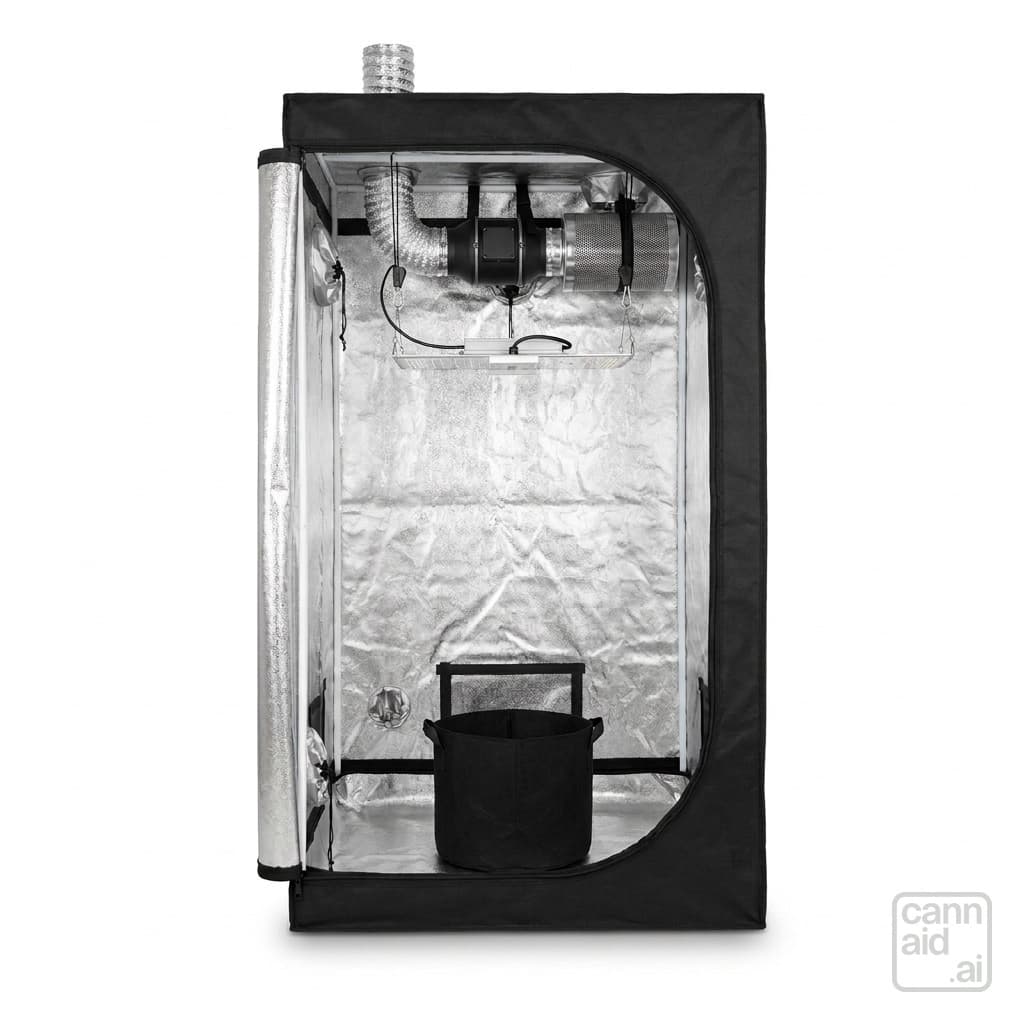
Size it to the grow you will actually run, not the one you imagine. A sixty-by-sixty tent holds one plant trained wide, and it is the cheapest room there is. A sixty-by-one-twenty holds two, or one bent into a table. That is the starter most people should buy, because it grows with you for a second and a third run before it feels small. A hundred-and-twenty square holds four plants and brings a real electricity bill. Height matters more than growers expect. A plant doubles in the stretch, and the lamp needs its distance above the tops. A short tent runs out of room by the fourth week of flower. So take the taller version of whatever footprint you choose.
What separates a good tent from a cheap one is the dark. Look for zips that let no pinprick through, and port sleeves that cinch closed around the ducting. The lining should be truly silver, not merely shiny. The frame should not sag under a lamp and a filter. When the new tent arrives, sit inside it with the room lit and the zips closed. Wherever a pinprick shows, tape it before a plant ever goes in. Growers often run this same dark test in a panic, the week the harvest starts throwing pollen. Run it on the day the box arrives instead.
The light — the sun you hang, sized to the walls
The lamp is where the money goes, and where the box lies hardest. A panel sold as a thousand watts may draw a hundred. A hundred and fifty true watts of good diodes will flower a sixty-by-sixty tent, and a quarter of a kilowatt a sixty-by-one-twenty. So read the wattage the lamp actually draws from the wall. After that, the number that matters is efficacy: how much plant-usable light each joule becomes. On efficacy, a good beats the old hot sodium lamps by half again, and it keeps the tent cool enough to sit beside. The rule of thumb is thirty-odd true watts for every square foot you mean to flower. The graph below sizes it for the common footprints.
The plant does not feel watts. What counts is the light landing on the leaves, measured as , and the need climbs through the grow. A seedling takes a few hundred and bleaches under more. Veg wants the middle hundreds. Flower wants the high hundreds, where the last of the yield is bought. A lamp's PPFD map, if the maker publishes one, tells you whether the corners see the same light as the middle. A phone app under the canopy gives you a rough read. A cheap quantum meter tells you exactly, and it is the first gadget on the upgrade list below. Hang the lamp on adjustable ratchets, because the distance is the dimmer you already own.
And read the plant, because she reads the lamp better than any meter. Too close, and the top leaves cup, bleach and go crisp at the tips. Too far, and she stretches pale and thin, with long bare stem between the nodes, reaching for a sun she cannot quite touch. The hand test is old and honest. Hold the back of your hand at the canopy for half a minute. If it is uncomfortable for you, it is uncomfortable for her. Keep the light gentle for seedlings, with the lamp dimmed or hung higher. Bring it closer through veg, and give her everything in flower. The Environment article walks that arc stage by stage.
The lamp, sized to the tent
The air — the exhaust, the filter, and the fan that moves her
A lamp makes heat and a plant makes water, and in a closed tent both climb by the hour. A hundred-and-twenty tent under a real lamp passes forty degrees within an hour if nothing pulls the air out. Meanwhile the plant breathes out enough water to fog the walls. The exhaust fixes both. An inline fan at the top of the tent pulls the hot, wet, used air out through the ducting. Fresh air comes in through the vents at the bottom, and the whole room turns over every minute or two. Size the fan to the tent's volume, its three sides multiplied. Then add a quarter for the carbon filter it breathes through, and a tenth for every bend in the duct. Each of those is a hand on the fan's throat. The graph below does the sum for the common tents.
The carbon filter is the part nobody plans for and everybody needs. A flowering plant smells like a flowering plant. Without a filter, the exhaust is a chimney for that smell. A canister of activated carbon in line with the fan scrubs the air before it leaves the tent. It works only if the filter is rated at or above the fan. It also needs the air inside to stay well short of saturated, because wet carbon stops catching the smell. Hang the filter inside the tent, up top where the warm air gathers, and let the fan pull through it. When the fan is right, the tent walls bow gently inward. That is negative pressure: every trace of smell leaves through the carbon, not through the zips. Passive intake, with the low vents left open, is enough for any tent this article sizes. A second fan blowing in is for whole rooms.
Then there is the air that stays. An exhaust changes the air, but it does not move it. Still air inside a tent is where mildew settles on a shaded leaf and rot sets into a dense bud. One small oscillating fan clipped to a pole keeps every leaf trembling. Turn it to sweep across the canopy, never straight at the plant. A leaf that flutters all day grows a stem that holds. This fan is the cheapest thing in the kit and the most often skipped. While she is small, aim it at the wall. She wants the breeze, not the blast.
The fan, sized to the tent
The pots and the pens — the ground, and your eyes underneath it
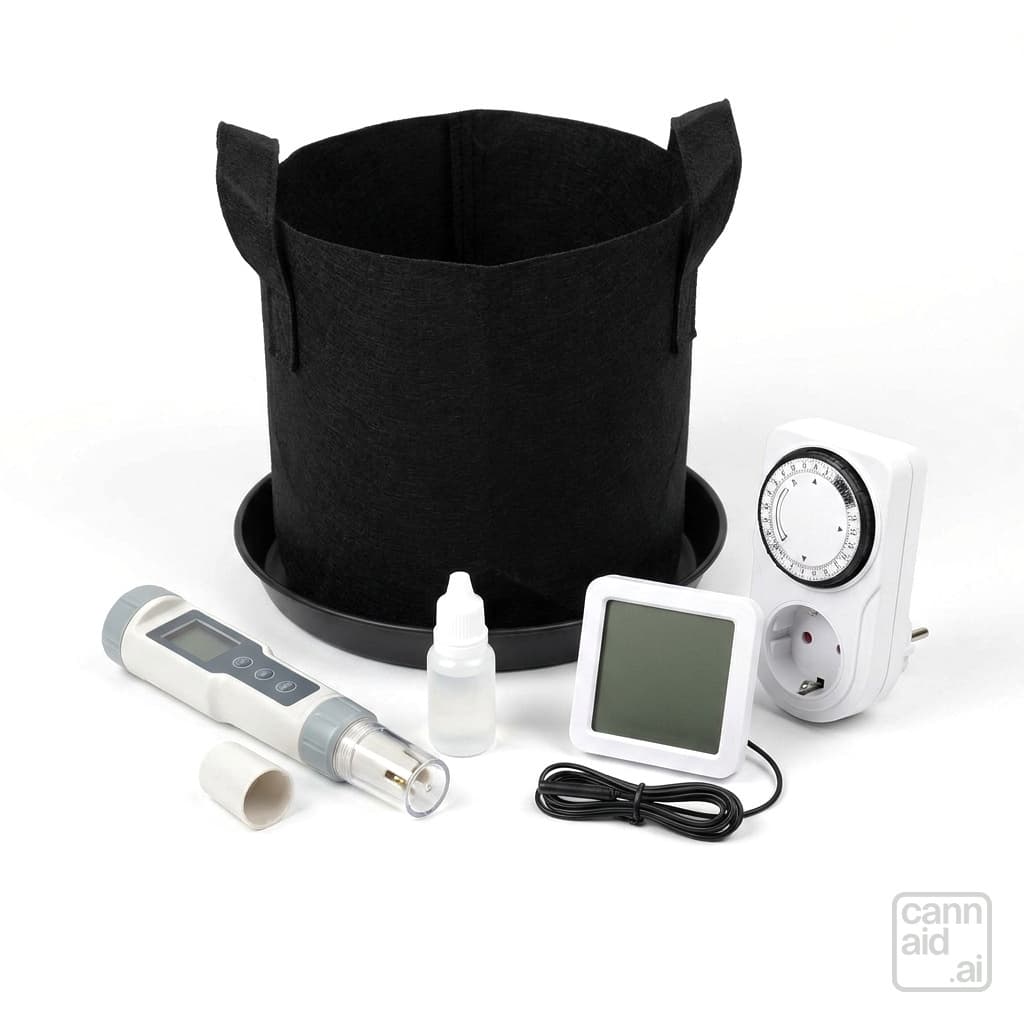
Below the canopy the kit is humble, and it decides more than the lamp does. A fabric pot breathes through its walls. Roots that reach the wall are pruned by the air, so they branch instead of circling. Water that would have sat and rotted them drains away. A saucer catches the so you can read it. A pot with no holes at all is the surest way this library knows to drown a seedling. Ten to twenty litres carries most plants through a normal veg, and twice that through a long one. The medium inside is the Mediums article's decision. For a first grow, choose a bag of quality living soil. It feeds the plant for the first month and forgives the mistakes the pens have not yet caught.
The pens are your eyes underground, and the pen is the one no grow can skip. Every nutrient crosses into the root only within a narrow band of acidity. In soil that band sits around six and a half. In coco it sits just under six, and in water a little lower still. Outside the band the plant starves over a full plate. It looks exactly like a deficiency and is not one: it is . A pen and a bottle of calibration fluid cost less than the cheapest lamp on the shelf. Together they retire half the problems in the health library before they start. An pen joins it the day you grow in coco or water. There you mix every meal yourself, and the runoff tells you whether salt is stacking up.
Above ground, two more. The first is a thermo-hygrometer with a min/max memory, hung at canopy height. It tells you what the tent did overnight, not just what it is doing now. The second is a plain timer on the lamp. The plant's whole calendar is the length of the night, and a timer that slips an hour is a light leak with a plug. Set both up before the seed. Read the hygrometer every morning against the arc the Environment article draws. Then the kit is complete. Everything you buy after this is a gadget, and a gadget waits for a reason.
The gadgets, earned in order
A gadget earns its place the way a technique does, by answering a problem you have measured. The first grow's job is to find those problems. Maybe the humidity would not drop in the last fortnight. Maybe one corner of the tent grew slower. Maybe you went away and the pots went dry. The second grow's job is to buy exactly one thing for each. So the list below runs in the order most growers earn it. It ends with the things most of them never should.
One rule runs through all of it: a gadget that measures earns its place before a gadget that acts. A meter tells you what the lamp does at the corners. A logging hygrometer tells you what the tent did while you slept. Only once you know can a dimmer, a dehumidifier or a second fan be aimed at anything. The room comes first, the eyes second, the hands last. And the survey and the health library read the plant the same way in any tent.