
CO₂: The Carbon Gamble
Whether adding CO₂ to your grow room pays off, the three things it needs first, and when it is money wasted.
What you'll learn
- What extra CO₂ actually does, and why it only helps once everything else is right.
- The three conditions, in order: a sealed room, a strong enough light, and a warmer room.
- Tank, burner or bag: what each one adds, what it costs, and which one does not work.
- When it pays and when it is money wasted, with every number on one sheet.
A plant builds most of her body from the air. Light powers the work, water carries it, and the minerals you feed build the machinery. But the sugar that becomes every stem and bud is made from carbon dioxide, CO₂, which the leaves take in through tiny pores on their undersides. Normal air holds only a little of it, about four parts in every ten thousand. Outdoors that is never a problem, because the wind keeps bringing fresh air. In a closed tent under a strong lamp, a plant can use up much of the CO₂ in an hour. When CO₂ runs low, she grows more slowly.
So some growers add CO₂ to the room, from a gas tank, a burner or a bag. It does work. A plant given about three times the normal CO₂, along with everything else she needs, grows faster and gives a heavier harvest. But there is a catch, and it is why this article calls it a gamble. Extra CO₂ only helps once nothing else is holding the plant back. If the light is too weak, the room too cool, or the feed or water off, extra CO₂ adds little or nothing. In most home tents, something else is holding her back. And if the tent has an exhaust fan, the CO₂ you add is blown straight outside.
This article walks through it in order. First comes what CO₂ changes, and the three things it needs before it changes anything: a sealed room, a strong lamp and a warmer room. Then the equipment, and what it costs to run. Then a plain answer on when it is worth it. For most growers the answer is no, and the money is better spent on a better light. If you have a sealed room and a strong lamp, every number is on the sheet at the end.
The gamble's curve
The graph shows the whole idea. Each line is how much bigger the harvest gets as you add more CO₂, under a lamp of a different strength. Under a weak lamp the line hardly rises, because the plant cannot use the extra CO₂. Under a strong lamp it rises steeply, then levels off. Past a certain point more CO₂ adds nothing, and much more starts to harm the plant. So the question is not whether CO₂ works. The question is whether your lamp is strong enough to put you on the top line.
Yield gain against the carbon in her air
Three conditions, in the order she needs them
Take the three conditions in order, because each one is useless without the one before it. First, the room must hold the CO₂, or it escapes before the plant can use it. Second, the lamp must be strong enough that light is no longer what the plant is short of. Third, once both are in place, the plant wants a warmer room than you would normally run. That third one surprises most growers.
The room — sealed, or the CO₂ escapes
Start with where the CO₂ goes. In most tents, it goes straight outside. A grow tent is cooled by its exhaust fan. The fan pulls warm air out through a carbon filter, and outside air is drawn in at the bottom to replace it, several times a minute. Any CO₂ you add leaves with that air. You could keep feeding a tank into a tent with a running exhaust fan, but most of the CO₂ you pay for would end up outside. So the first condition is not equipment. It is the kind of room. A sealed room has no exhaust fan. An air conditioner cools it without bringing in outside air, a dehumidifier dries it, and the CO₂ you add stays inside.
Sealing a room takes work more than money. Put weather-strip around the door, block the air intakes, and tape the seams of the ducting. Then test it. Light a stick of incense, watch where the smoke drifts, and follow it to the gap. A sealed room changes how you grow in it. The plants give off water all day and nothing carries it away, so the dehumidifier runs all the time. No fresh air comes in, so while the lights are on, the plants use up the CO₂ quickly if you stop adding it. And the lamp's heat can only leave through the air conditioner. It is a different way of growing, and CO₂ is the last step of it, not the first.
This is where most readers get their answer. A tent with an exhaust fan cannot hold extra CO₂, and no controller changes that, because the fan removes CO₂ faster than any tank can add it. A greenhouse leaks by design, unless one part of it is sealed and cooled on its own. Only a sealed room with its own cooling can hold CO₂. If you grow in a tent, the rest of this article describes a setup you do not have. The useful lesson for you is where to spend the money instead: on getting the room's climate right, under a better lamp.
Where the carbon goes
Light and heat — the levels that make CO₂ worth it
Plants only use CO₂ while the lights are on. Most home lamps are not strong enough for extra CO₂ to matter: the plant runs out of light before she runs out of CO₂. Adding CO₂ to a plant that is short of light does almost nothing, and most of it just sits in the air. So the second condition is a lamp strong enough that light stops being the limit. Measure the light at the top of the plants with a meter, in , instead of trusting the number on the box. The light also has to stay strong from the top of the canopy to the bottom. Under a lamp like that, extra CO₂ starts to help. Under a weaker one it adds only a few percent, however much you add.
Then comes the surprise: with more CO₂ in the air, the plant wants it warmer. runs faster in warmth, and a plant with plenty of CO₂ can work well at temperatures that would stress her in normal air, from the high twenties into the low thirties. In normal air at those temperatures, a plant closes her pores and stalls in the heat. So growers with sealed rooms run them warm on purpose. The extra heat is part of the method, not a side effect of the lamp. One thing does not change: warm air needs more moisture in it. A dry room at thirty degrees pulls water out of the leaves faster than the roots can replace it, and the plant wilts. So raise the humidity as you raise the heat, and keep the in its range. If you do not, the plant closes her pores and the extra CO₂ goes unused.
Timing follows from when the plant can use CO₂. Turn it on with the lights, and turn it off an hour or two before the lights go out. In the dark a plant gives off CO₂ instead of taking it in, so adding CO₂ at night is money wasted. A controller with a sensor at the height of the plants keeps the level in the right range for you. A plain timer and a regulator can do a rougher job, if you would rather set the amounts yourself. Either way, aim well below the upper limit. Past the point where the graph's lines go flat, more CO₂ adds nothing. Far beyond it, the air becomes unsafe for you to breathe. That limit is on the sheet at the end.
Her comfort moves with the carbon
The gear and the bill — tank, burner, and the bag that does nothing
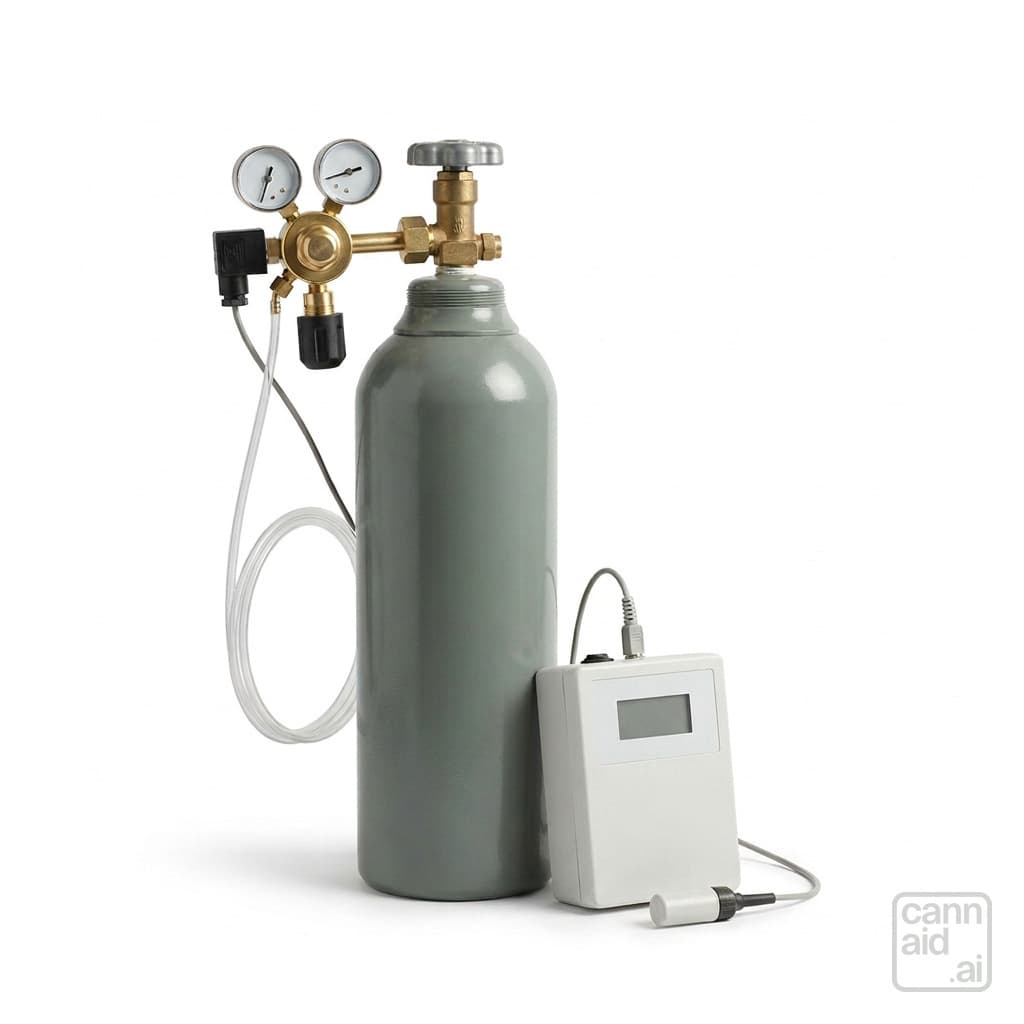
There are three ways to add CO₂ to a room, and only two of them work. The tank is the choice for a small grow. It is a cylinder of compressed CO₂, with a regulator that sets the flow and a valve that the controller opens and closes. The running cost is a refill every few weeks. A tank adds no heat, no water and no flame, and it is precise. For a sealed room the size of a bedroom, it is all you need. The burner is the choice for large grows. It burns propane or natural gas, and the flame makes CO₂. It also makes heat and water vapour, and it is a fire risk. It is cheap to run, but in a small room the air conditioner would have to remove its heat all day.
The third way is a CO₂ bag. It is a bag of growing mushroom mycelium (the root-like part of a fungus), or a bucket of yeast and sugar, that gives off a little CO₂ as it grows or ferments. It does not work, for two reasons. First, it makes very little CO₂, only a small fraction of the target level on the sheet. Second, a tent with an exhaust fan swaps its air several times a minute, and the small amount the bag makes goes out with it. Even in a sealed room, a bag adds far too little to reach the target. A grower with a sealed room buys a tank instead, which does the job properly. So the bag is sold to growers in tents, the very people it cannot help. Skip it, and put the money into a better light instead.
Then add up the costs. The tank refill is the smallest part. The real costs are the air conditioner running all day to keep a sealed room cool, the dehumidifier beside it, and the stronger lamp that extra CO₂ needs. You pay for all of them whether the CO₂ pays off or not. In return, a well-run room can give about a third more flower, every harvest. That is worth a lot in a large grow, and almost nothing for one plant in a cupboard. The full numbers are on the sheet at the end. The short rule is this: if your plants are not already growing as well as your room allows, CO₂ will not fix that. It will only make the same problems cost more.
Is it worth it?
Go through the three conditions like a checklist. Most growers get their answer at the first one. No sealed room means no CO₂: it leaves with the exhaust, and a bag never makes enough to matter. A sealed room under a weak lamp should get a better lamp first. Under a weak lamp, CO₂ adds a few percent, while a better lamp adds far more. A sealed room under a strong lamp, kept warm and humid, with the feed and water already right, is the setup this article is for.
Even then, add CO₂ last, and turn it off first when anything goes wrong. CO₂ makes a good room better. It does not hide or fix problems. A deficiency or a pest in a CO₂-enriched room is the same problem, growing faster. Get the plant healthy first. The survey reads her leaves the same way in any air. Then, if the room is sealed and the lamp is strong, add the CO₂.
The numbers
All the numbers in one place. Read them with the graph above and the three conditions.