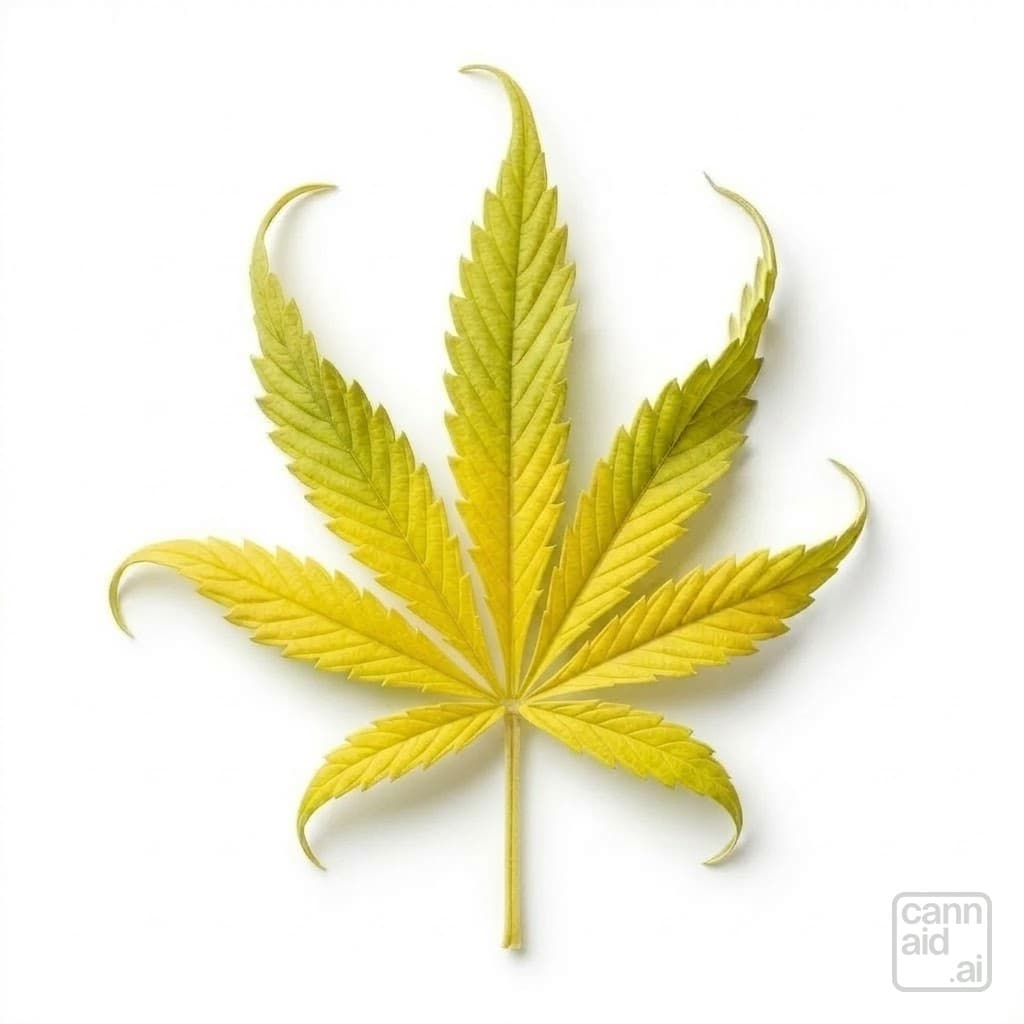
Yellowing new growth from leaf base, pink/red undersides
Sulfur is a secondary macronutrient that's quietly load-bearing across cannabis biology. It builds key amino acids (cysteine, methionine) and vitamins (biotin, thiamine), supports production and fatty acid metabolism, and strengthens disease and cold resistance. Here's the cannabis-specific kicker: sulfur is literally part of the "skunky" aroma chemistry. Volatile sulfur compounds are the molecules that give cannabis its signature smell — the sulfur atoms are the aroma, not just involved in making it. These compounds peak during late flowering and curing, which is why S-starved plants come out bland.
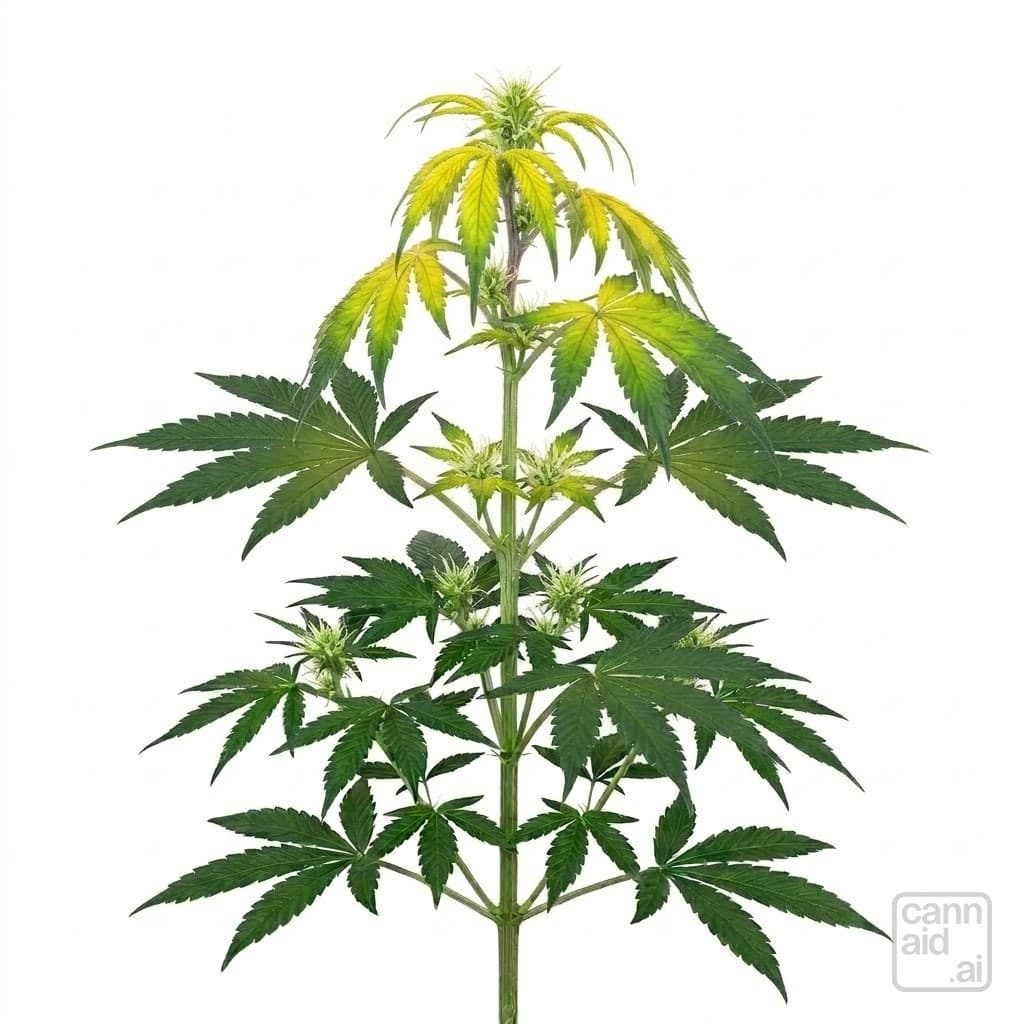
S deficiency is uncommon because most complete fertilizers, tap water, and even atmospheric deposition provide enough sulfur to keep the plant supplied. It's most likely in pure hydroponic systems, in heavily leached sandy soils, or when soil drops below 5.5 (which locks S out — on the alkaline side it holds on until past 8.5). Because sulfur is semi-mobile, deficiency starts in the mid-canopy and on younger leaves — not at the very bottom like nitrogen, and not exclusively at the top like fully immobile nutrients. That mid-to-upper position is the diagnostic distinction. On individual leaves, the yellowing starts at the base near the and spreads outward toward the tips. The most reliable confirmation is pink, red, or orange coloration on the undersides of affected leaves — flip a leaf over and check. Left uncorrected, S deficiency tanks terpene and aroma production. Expect bland, weak buds. Research shows yield reductions up to 34% in sulfur-starved plants.
Solutions
✓Add Epsom salt (magnesium sulfate) — provides both Mg and S
✓Use gypsum (calcium sulfate) to add S without raising pH
✓Check pH — sulfur locks out below 5.5, and on the high side only past 8.5 in soil, 8.0 in coco, 7.6 in hydro
✓Most complete fertilizers contain adequate sulfur — check your label before adding more
✓Foliar spray with sulfur-containing products for quick uptake while root zone corrections take effect
Plant Overview
How it moves through the plant
Sulfur is semi-mobile — the plant can shuffle some between tissues but not freely the way she does with nitrogen. The result is that deficiency starts in the mid-canopy and on younger leaves: not at the very bottom (that's N's territory), not exclusively at the top (Fe or Ca territory). The signature is uniform yellowing on younger leaves combined with pink, red, or orange tones on the leaf undersides. That underside coloration is the most reliable diagnostic and distinguishes S from iron, which it otherwise resembles.
Early. Mid-canopy and upper leaves take on a uniform pale-green-to-yellow cast — not the very bottom of the plant, and not strictly the top. The semi-mobile mid-to-upper position is the diagnostic giveaway. New growth at the top often comes in noticeably lighter than the older leaves below. The whole plant takes on a slightly muted look, and aroma from new growth is reduced — experienced growers often notice this before the color fully shifts.
Mid. The yellow has spread across most of the upper third of the plant. From a few feet away the contrast between the dull yellow upper canopy and the still-darker lower canopy is clear. Flip a few of the worst-affected leaves over and you'll see pink, red, or orange tones on the undersides — the most reliable way to confirm S over Fe at this stage. Growth has visibly slowed but the plant keeps pushing new tissue.
Late. The upper canopy has gone completely yellow or whitish, with the yellowing spreading down into older leaves. From across the room the plant looks visibly starved — pale upper canopy with woody tough stems and a compact, stunted growth pattern. If she's flowering, buds shrink and fail to thicken, and the aroma is noticeably weak and bland (remember: sulfur is literally part of the "skunk" aroma chemistry). Yield can drop up to 34% in severe cases.
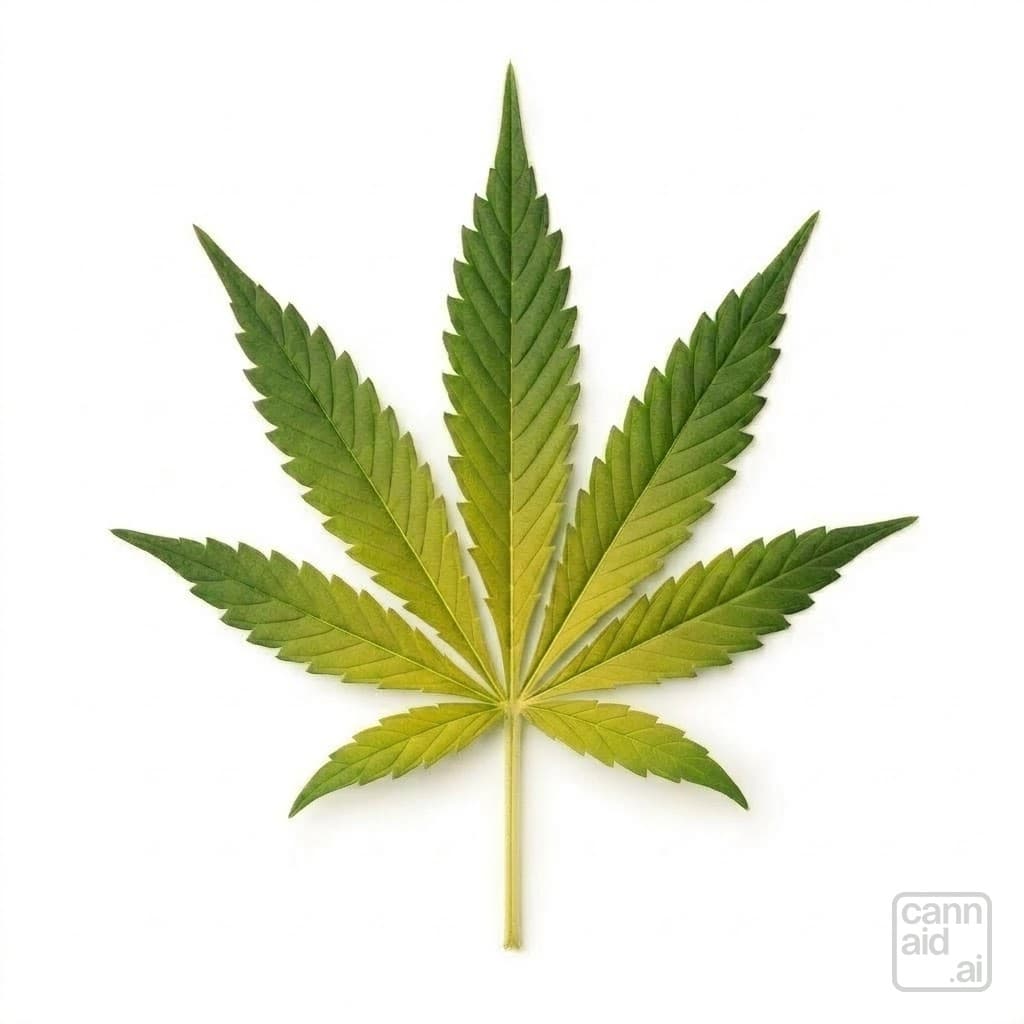
Early — how it first appears on a leaf
Pick up a mid-canopy or upper leaf in the early stage and the yellowing is uniform — and tissue dimming together at the same rate, unlike iron where the veins stay sharply green. The yellow starts at the base of the leaflet near the and spreads outward toward the tips. The leaf still feels soft and normal in texture. Stems may stay green while the lightens. New growth coming in may be smaller than expected, and aroma from new tissue is noticeably reduced — even before the color fully shifts.
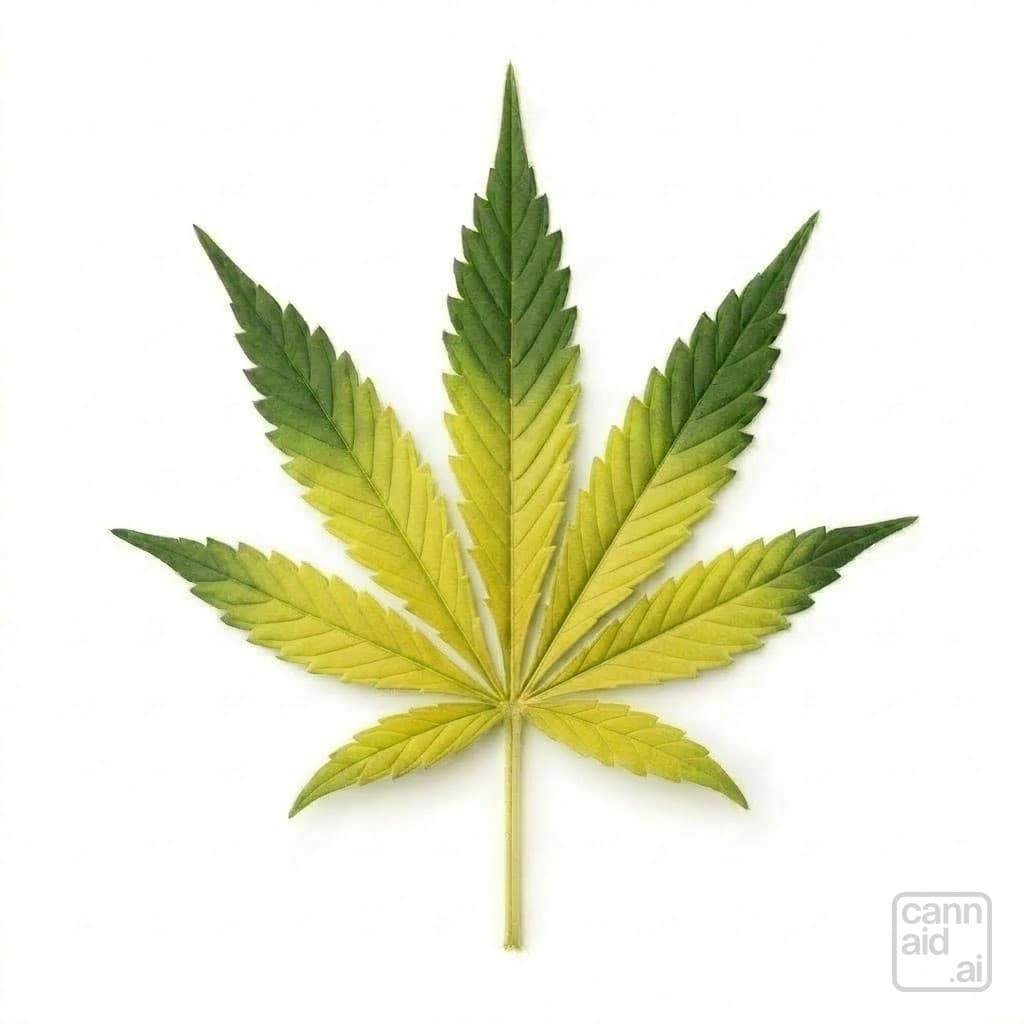
Mid — when the underside tells
By the mid stage on the same upper leaf, the yellowing has intensified and the leaf is distinctly pale across most of the blade. The base-to-tip progression continues — the leaf base near the petiole is the most yellow, with the yellow stretching toward the tips. Interveinal chlorosis may begin developing on some leaves, but the dominant pattern stays uniform. Flip the leaf over: if you see pink, red, or orange tones on the underside, that's your definitive S diagnosis (Fe doesn't do that).
Late — past the point of recovery
By the late stage, the leaf has turned completely yellow or whitish throughout the blade. The underside shows pronounced pink, red, or orange coloration — confirmation that this is sulfur. The leaf has gone dry, stiff, and brittle. Tips may curl downward and look burnt. The leaf has the texture of one that hasn't been able to make chlorophyll for some time.
Commonly Confused With
Iron (Fe)
Both yellow new/upper leaves. Sulfur yellows the entire leaf uniformly including veins; iron keeps veins distinctly green (interveinal chlorosis). Sulfur yellowing starts from the leaf base near the petiole; iron shows a sharp fishbone pattern across the whole blade. Pink or red leaf undersides confirm sulfur.
Both cause uniform yellowing without interveinal patterns. Nitrogen is mobile, so it hits lower/older leaves first; sulfur is semi-mobile, so it hits mid-to-upper leaves first. If yellowing starts at the bottom of the plant, it's nitrogen. If it starts in the middle or top, it's sulfur.
Healthy new leaves are naturally pale but darken within days. Sulfur-deficient leaves stay yellow, may develop pink/red undersides, and the yellowing spreads from the leaf base outward instead of being uniform.