Calcium is the plant's structural cement. It binds into cell walls and membranes, giving them the rigidity that holds the plant together — without enough Ca, cell division slows and new tissue comes out weak and malformed. Beyond pure structure, calcium acts as a secondary messenger inside cells, helping the plant respond to stress and coordinate growth. It's critical for root tip development and keeping stems strong. There's one important catch: calcium moves through the plant exclusively in the transpiration stream — pulled one-way upward through the xylem as the leaves lose water to the air. Anything that slows that transpiration (low humidity, cold root zones, poor airflow) can starve her new growth of Ca even when there's plenty of it sitting in the medium.
Ca deficiency shows up most often in coco coir (which naturally binds calcium tight), in soft water areas, and in RO water setups where growers haven't added cal-mag. LED and HID growers run into it too — intense lighting pushes faster growth without necessarily bumping up transpiration enough to deliver calcium where it's needed. Cold root zones and both slow Ca uptake even when your feed numbers look perfect. Because calcium is immobile, symptoms always show up on new growth first — typically the top of the . Exception during flowering: the plant may show Ca symptoms on lower first as she prioritizes Ca toward the developing buds. Unlike magnesium or iron deficiency, which both produce clean interveinal yellowing, calcium produces brown spots combined with structural distortion — twisted leaves, cupped edges, and eventually hollow stems. That hollow stem is unique to Ca and a reliable identifier; no other deficiency causes it.
Solutions
✓Add cal-mag supplement to feeding schedule — LED/HID growers may need higher doses
✓Check pH — optimal 6.3–6.8 in soil, 5.8–6.0 in coco, 5.5–6.0 in hydro
✓Add dolomite lime or gypsum to soil before planting
✓Avoid overwatering which inhibits calcium transport through roots
✓Maintain humidity at 45–65% and good airflow for proper transpiration
Plant Overview
How it moves through the plant
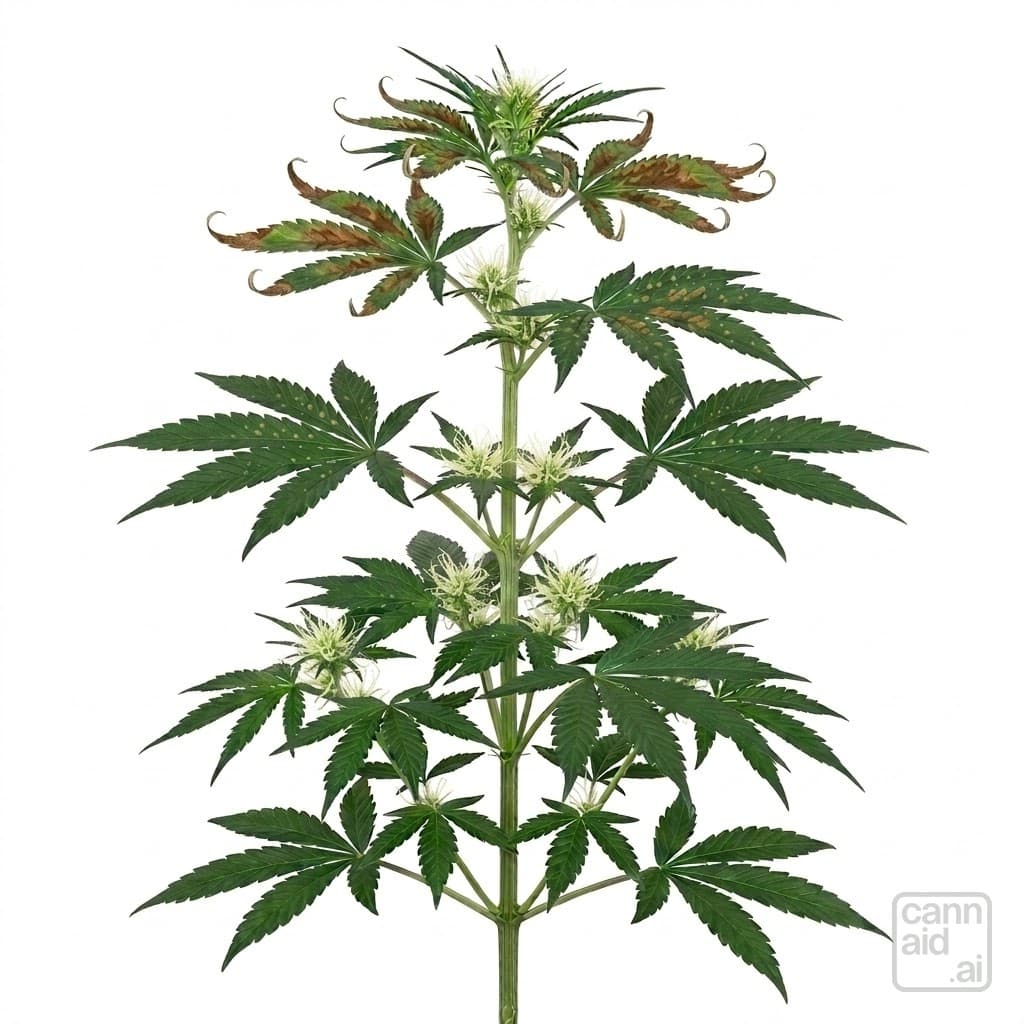
Calcium is immobile — once the plant locks Ca into cell walls, that's where it stays. There's no reservoir of Ca in older tissue she can raid when supply runs short, so new growth at the top of the plant is always the first to suffer. Ca deficiency walks top-down, or simply stalls at the growing points. The signature isn't yellowing — it's structural deformity: brown rust spots on young leaves combined with twisting, cupping, and crinkling. Hollow stems develop in late stages and are unique to Ca — no other deficiency produces them.
Early. Only the top one or two new are affected — they come in visibly malformed, irregular in shape, off-kilter compared to a clean healthy new leaf set. Everything below stays vibrant and normal. Growth at the apex has slowed compared to the steady pace of the lower canopy.
Mid. The distortion has spread to multiple emerging leaves, not just the freshest one or two. From a few feet away the upper canopy looks visibly twisted and crinkled against the still-vibrant mid and lower canopy. spacing at the apex tightens noticeably, and overall growth at the top has slowed to a crawl while the lower canopy keeps pace.
Late. Growing points die or become necrotic at the top of the plant — the apex stalls completely. From across the room the top of the canopy looks severely twisted and damaged. The diagnostic late-stage feature is hollow stems: pinch a young stem near the apex and it caves under your fingers. During flowering, calyces come in distorted and fail to fill out. Heat tolerance also drops at this stage, so a warm grow room is doubly risky when Ca is in late deficiency.
Early — how it first appears on a leaf
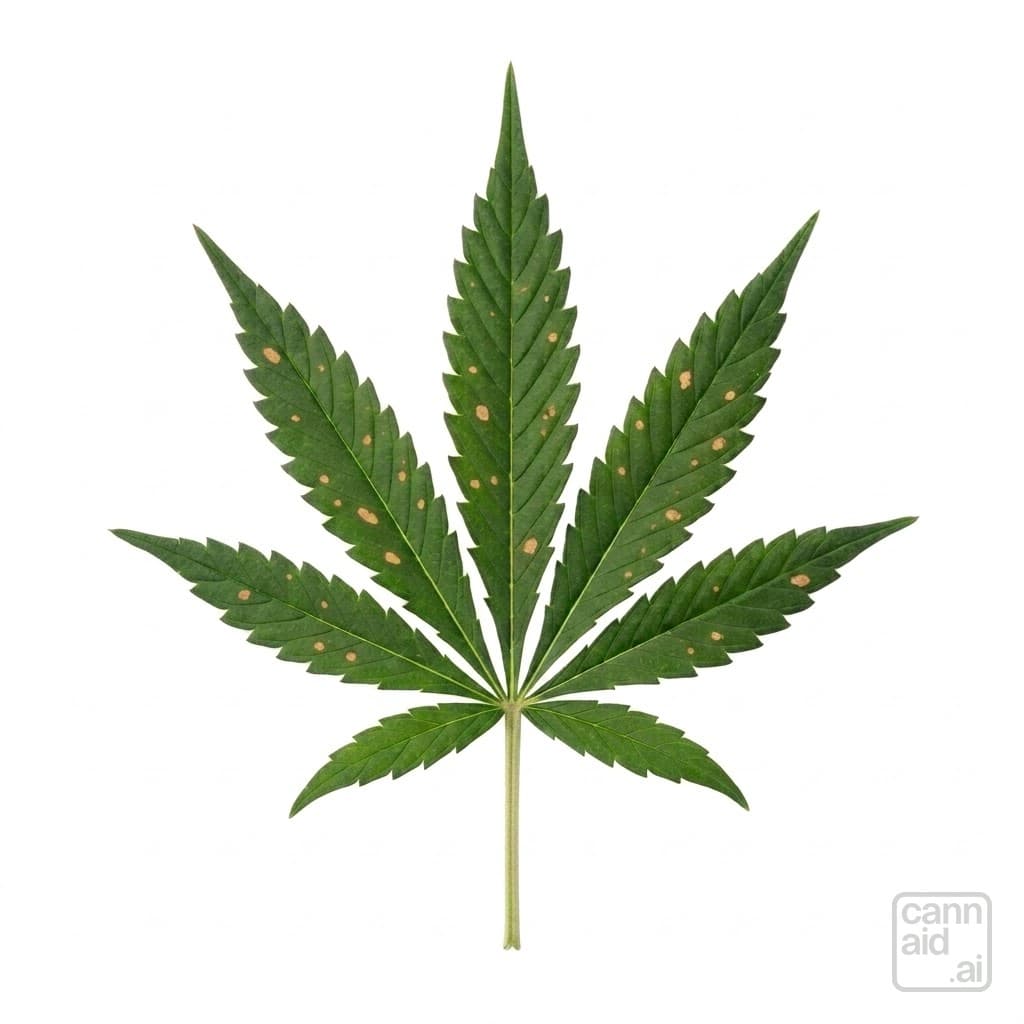
Pick up a new upper leaf in the early stage and the main story is distortion, not discoloration. The leaf comes in wrinkled, with cupped or irregularly-shaped edges. Small brown, bronze, or rust-colored spots dot the . The base of each leaflet may look visibly narrower than a healthy leaflet, with a lighter green band right at the leaflet base — subtle but a real tell when you spot it. The leaf may show deeper green coloration before the spots fully develop. Margins and tips may have started to go necrotic. Young shoots in the area may show purple discoloration.
Mid — when distortion becomes severe
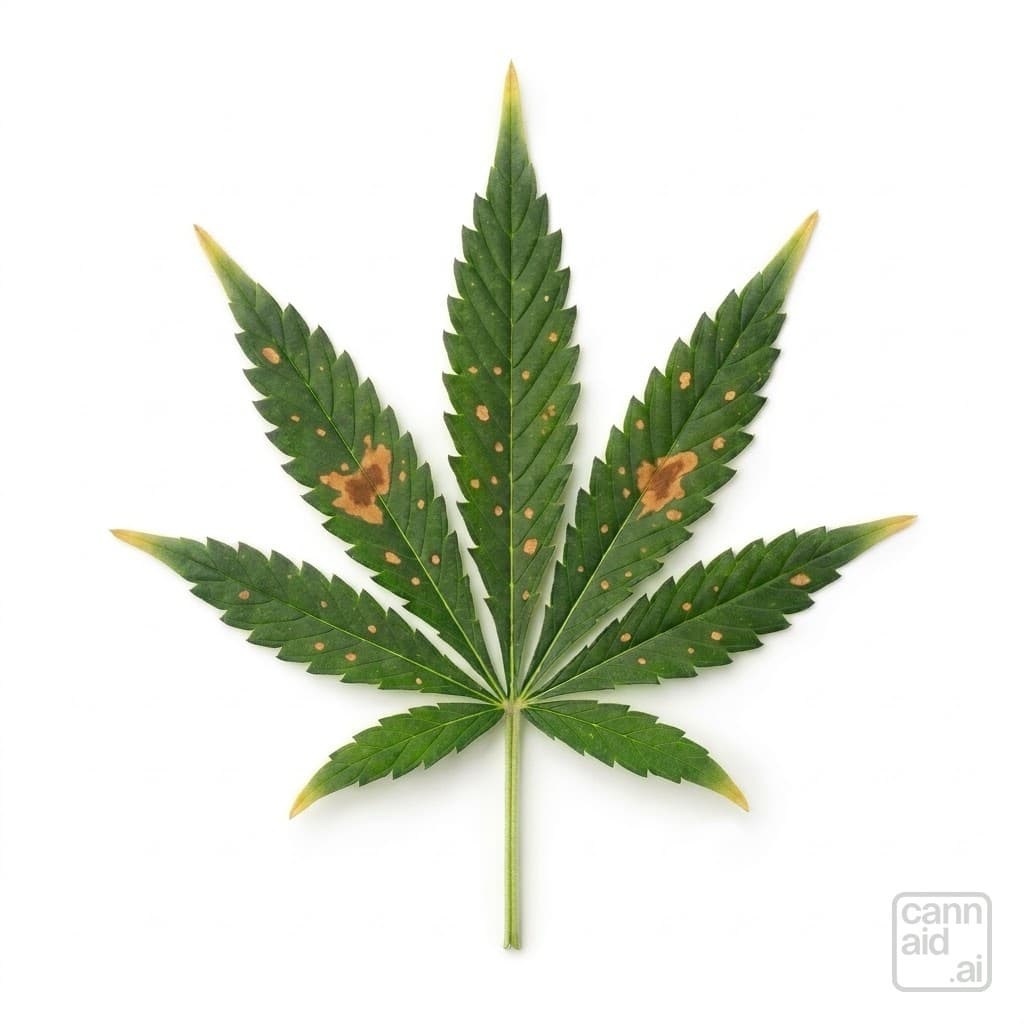
By the mid stage on a single new leaf, the distortion has gone severe — the leaf is markedly twisted, crinkled, or cupped, and the deformation worsens with each new leaf set. Rust-brown spots have enlarged and merged into larger patches across the blade. The persistent light-green band at the leaflet base has broadened into a faint interveinal extending partway across the leaflets. Marginal yellowing is now evident. Leaf cupping continues to tighten.
Late — past the point of recovery
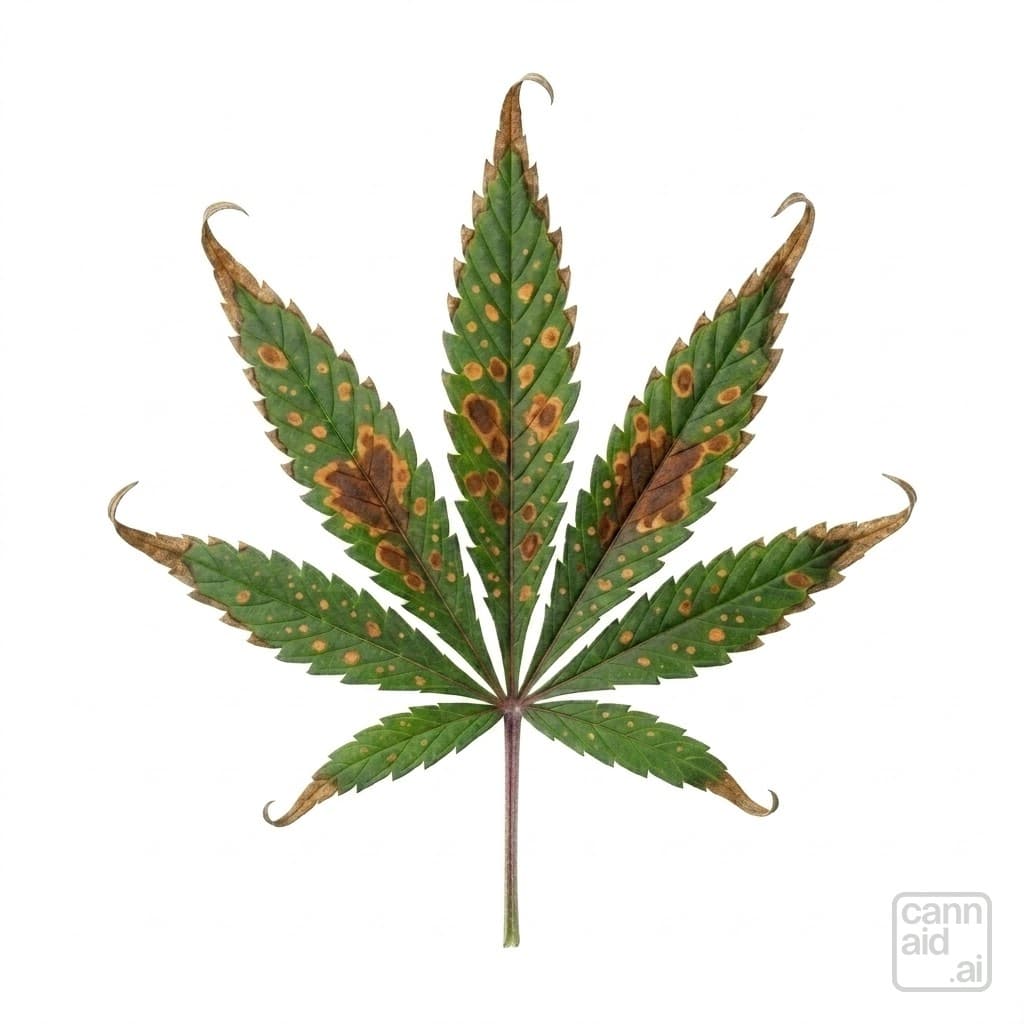
By the late stage, the leaf is severely twisted, crinkled, or cupped, with margins and tips fully necrotic and brittle. Growing points adjacent to the leaf may be dead or dying. The underside may show purple or reddish discoloration. Tissue has gone brittle and breaks off easily. The connecting the leaf to the plant may be hollow when you squeeze it — a Ca-specific diagnostic. New leaves above this point may fail to form at all as the growing tip dies back.
Commonly Confused With
Leaf Septoria
Both produce spots on leaves. Calcium spots appear on upper/new growth with irregular rust-brown edges. Septoria spots appear on lower/old leaves, are round with dark borders, and have tiny black dots (pycnidia) inside.
Both affect new growth and can cause hollow stems. Calcium makes stems brittle with rust-brown spots on leaves. Boron makes stems soft and mushy with tips dying back entirely. Stem texture is the fastest check: brittle = calcium, soft = boron.
Both produce brown spots. Calcium spots appear on upper/new growth. Potassium spots appear on lower/old leaves with crispy margins. Leaf location is the fastest way to tell them apart.