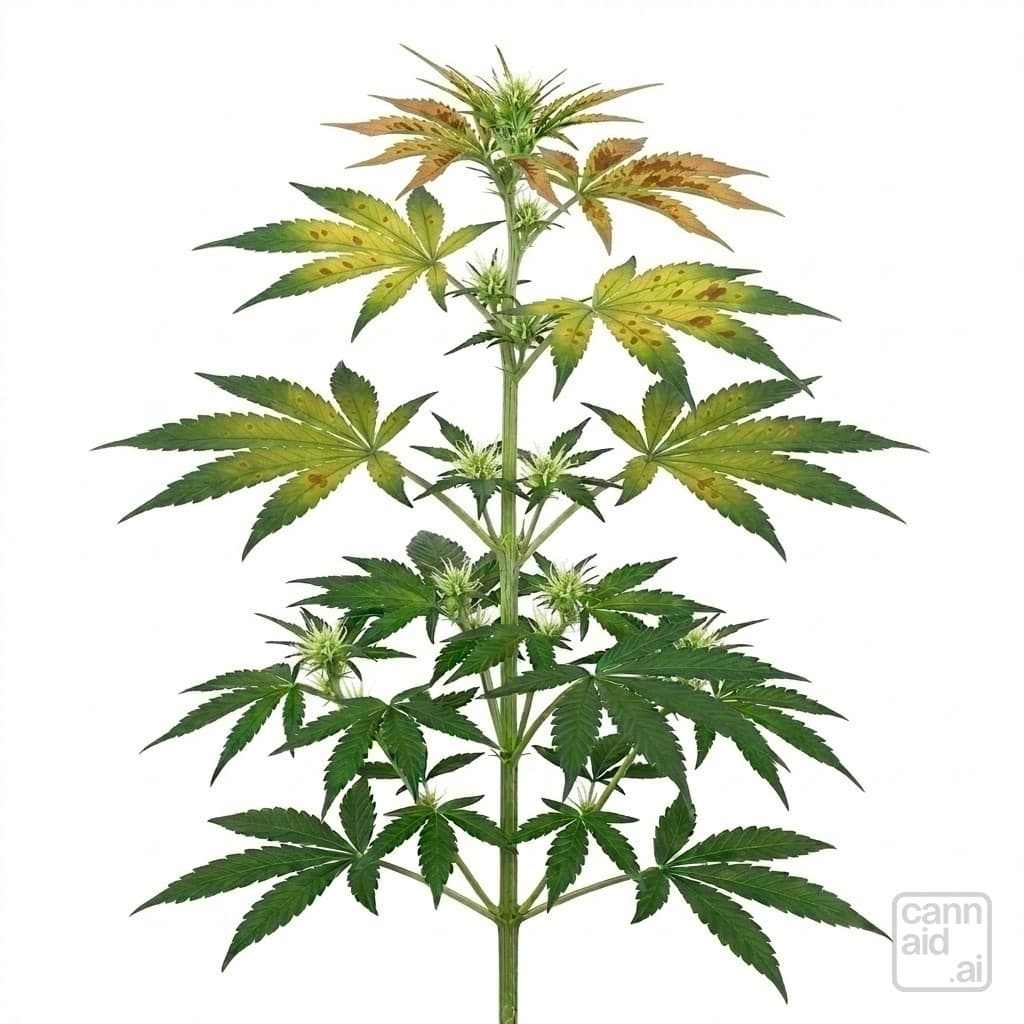
Speckled interveinal chlorosis with tan spots on upper growth
Manganese is a micronutrient with one outsized job: it sits at the core of the water-splitting reaction in — the step where your plant cracks water apart to release oxygen. No Mn, no oxygen production, and the whole light-dependent chain stalls. Mn also activates more than 35 enzymes involved in fatty acid synthesis, respiration, and nitrogen metabolism, drives production, and protects cells from oxidative damage. She uses tiny amounts of it, but those tiny amounts run a big chunk of the energy machinery.
Mn deficiency is most often triggered by soil above 7.0 (6.5 in coco, 6.1 in hydro), which locks Mn out fast in alkaline conditions. Excess iron can also cause Mn deficiency through Fe-Mn antagonism — heavy iron supplementation without balancing Mn is a common secondary trigger. Because Mn is immobile, deficiency hits new upper growth first — the same position iron deficiency takes. So how do you tell them apart? One word: spots. Manganese produces small tan or brown necrotic spots scattered through the yellow interveinal tissue from early on. Iron produces clean yellowing with no spots at any stage. As things progress, Mn yellowing shifts toward tan and brown while Fe bleaches toward white or gray. The spots tell.
Solutions
✓Lower pH — Mn locks out above 7.0 in soil, 6.5 in coco, 6.1 in hydro
✓Add manganese sulfate as a targeted supplement
✓Check for excess iron or calcium — both compete with Mn for uptake
✓Avoid overliming or over-buffering, which pushes pH too high
✓Foliar spray with a manganese-containing product for quick uptake while root zone corrections take effect
Plant Overview
How it moves through the plant
Manganese is immobile — once she's used it, that's it, she can't pull it back out and ship it up to new growth. So when supply runs short, the new growth at the top of the canopy is the first to suffer; older leaves below stay normal. The signature visual is mottled, speckled interveinal with tan or brown necrotic spots showing from the early stage. That combination — interveinal yellowing PLUS spots — is what distinguishes Mn from iron, which produces clean spotless yellowing in the same upper-canopy position. If you see spots, it's Mn.
Early. Just the top one or two new show the start of the mottled, speckled pattern. The contrast against the still-vibrant lower and mid is subtle but visible up close. New leaves, shoots, and internodes come in slightly undersized — Mn is involved in building tissue itself, so when she's short on it, the new growth doesn't develop properly. Apex growth has slowed.
Mid. The mottled chlorosis has spread across multiple leaves at the top of the canopy. From a few feet away the upper canopy reads as patchy and yellow against the still-normal lower canopy — the leaves up top look almost like someone flicked drops of weak tea across them. The size reduction is now obvious; new shoots and leaves are noticeably smaller than what the plant was producing weeks ago. Growth at the top has slowed significantly.
Late. The top of the canopy is heavily damaged — yellowing has shifted to tan and brown across multiple leaves, dead patches are spreading, and new growth barely extends. From across the room the upper plant looks shriveled and patchy compared to the still-normal lower canopy. Affected leaves wilt and drop prematurely. The plant looks visibly stalled at the top while the lower canopy still tries to hold things together. If she's flowering, bud development at the top takes a real hit.
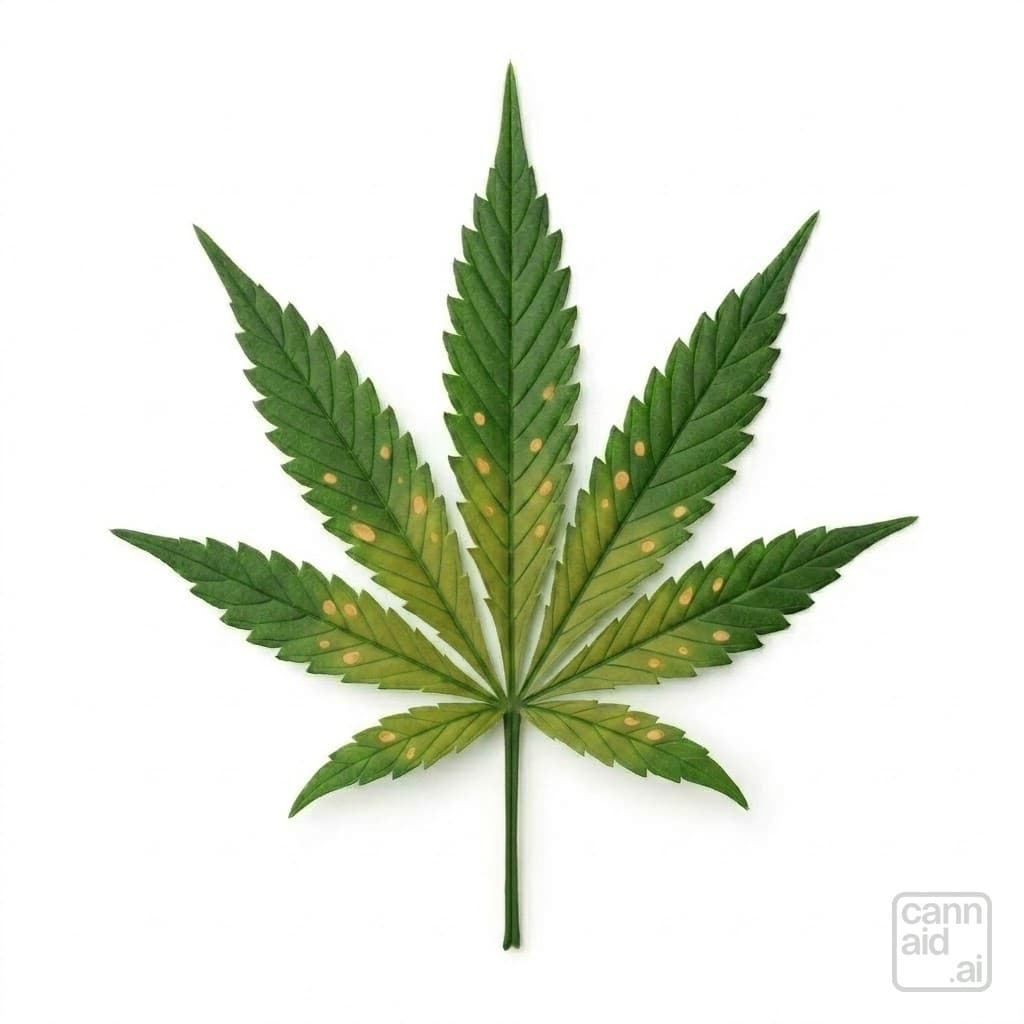
Early — how it first appears on a leaf
Pick up a new upper leaf in the early stage and you'll see a pale color developing between the while the veins themselves stay green. The interveinal pattern is messier and less distinct than iron produces — that's the first hint this is Mn, not Fe. Then look for the smoking-gun detail: small tan or light brown necrotic spots starting to form in the yellow tissue between veins, scattered across the . Iron doesn't produce spots; manganese does. The leaf takes on a speckled, mottled appearance — like someone flicked a few drops of weak tea across the surface.
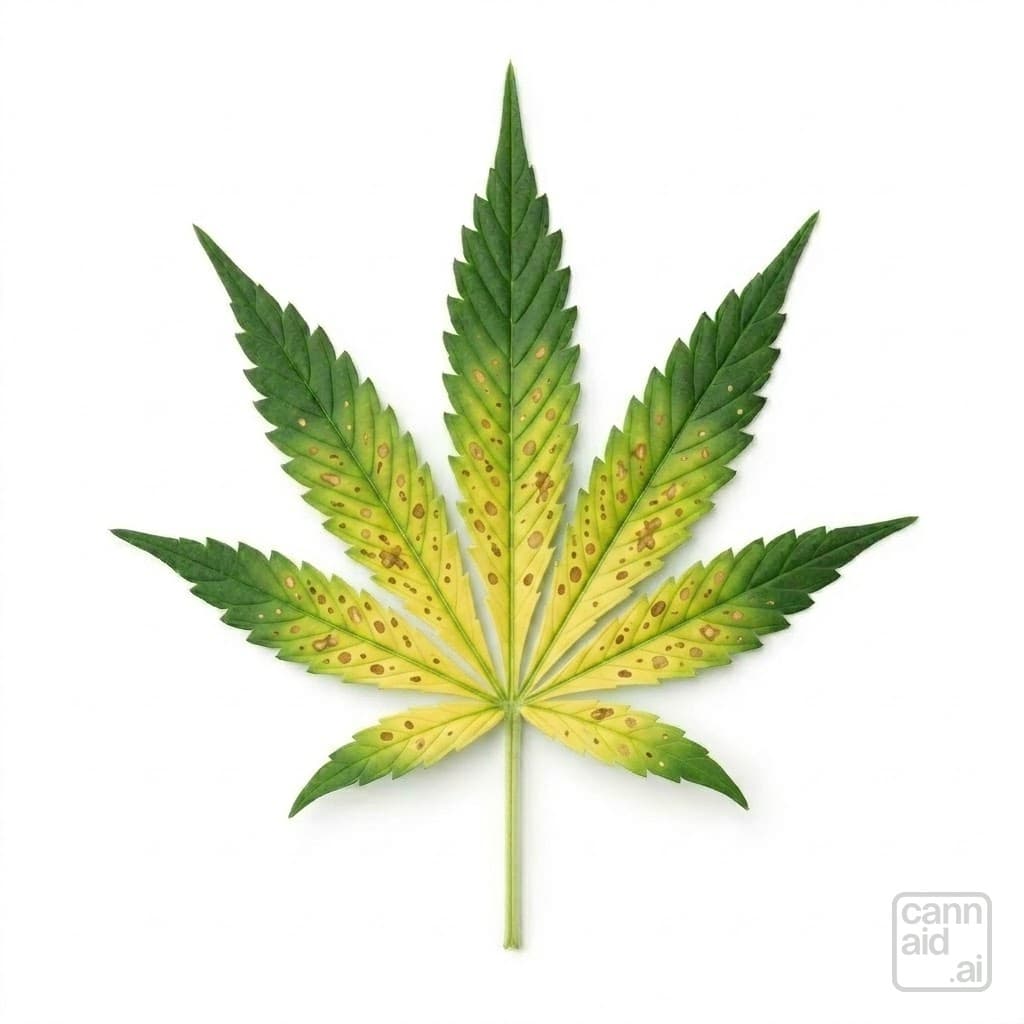
Mid — when the speckled pattern locks in
By the mid stage that same leaf has settled into a clear mottled chlorosis pattern. Green veins stand sharply against yellow inter-vein tissue, and the necrotic tan spots from the early stage have enlarged into small patches. Run a finger across the blade and you can feel where the dead spots have started to crisp up — they break the smooth surface. The leaf is also visibly smaller than a healthy leaf would be at this stage; Mn shortage stunts the leaf itself, not just its color.
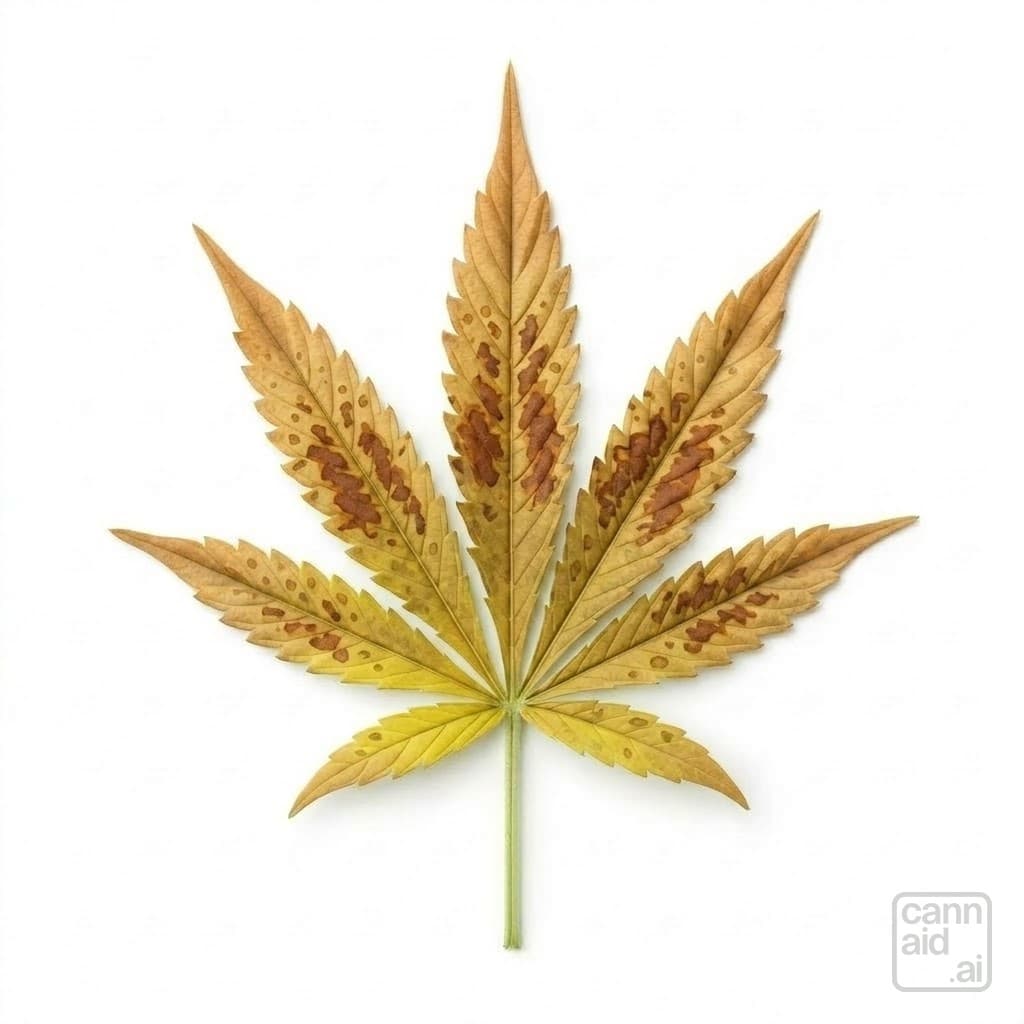
Late — past the point of recovery
By the late stage the leaf has shifted from yellow into tan and brown across most of the blade. The necrotic spots have spread and merged into large dead patches that crumble when you touch them. The whole leaf has a ragged, mottled look — patchy where there's still green, brown where there isn't. Dead areas are dry and papery; some sections fragment or shred outright. The leaf is significantly undersized compared to what it should be, and it eventually wilts and drops. A leaf this far gone isn't coming back.
Commonly Confused With
Iron (Fe)
Both cause immobile interveinal chlorosis on new growth. Manganese produces a messy mottled pattern with tan/brown spots early on. Iron produces a clean, sharp interveinal pattern with no spots and can progress to white. Spots vs no spots is the fastest check.
Both affect new growth. Manganese causes mottled spots on normal-sized leaves. Zinc produces small, twisted leaves with shortened internodes. If the leaves are structurally deformed, it's zinc.
Pale new leaves can resemble early manganese deficiency. Healthy new growth greens up within a few days. Manganese-deficient leaves develop a mottled pattern with tan spots that worsen over time.